
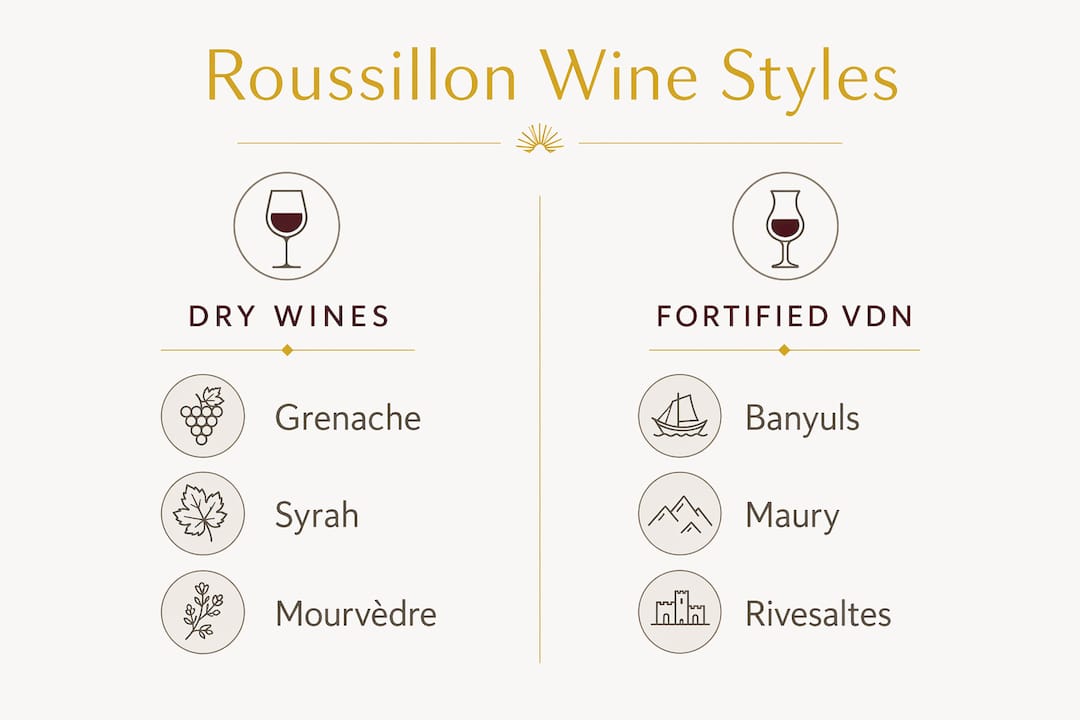
Roussillon wine is defined as a distinct category of French wine produced in the far south of France, between the Pyrenees and the Mediterranean, celebrated for its extraordinary range of dry reds, whites, and fortified sweet wines known as Vin Doux Naturel. The region sits within the broader Languedoc-Roussillon area but holds its own identity, shaped by schist soils, fierce winds, and some of the oldest vine stock in France. Grenache Noir, Carignan, Syrah, Mourvèdre, Grenache Blanc, and Macabeu are the signature varieties. What makes Roussillon genuinely exciting is the sheer breadth of styles it produces, from bone-dry old-vine whites to richly oxidative fortified wines that age for decades.
What are the main appellations and grape varieties of roussillon?
Roussillon holds 14 AOPs (Appellations d’Origine Protégée) and 2 IGPs, making it one of the most appellation-rich regions in southern France. The diversity of Roussillon’s appellations can feel complex at first, but the core appellations each have a clear identity. The region’s geographical position between the Mediterranean and the Pyrenees shapes its mosaic of terroirs, which is a core strength rather than a complication.
| Appellation | Primary Grapes | Key Style |
|---|---|---|
| Côtes du Roussillon | Grenache, Carignan, Syrah | Dry red, white, rosé |
| Côtes du Roussillon Villages | Grenache Noir, Mourvèdre | Structured dry red |
| Banyuls | Grenache Noir, Carignan | Fortified sweet (VDN) |
| Banyuls Grand Cru | Grenache Noir (min. 75%) | Oxidative fortified sweet |
| Maury | Grenache Noir | Fortified sweet (VDN) |
| Muscat de Rivesaltes | Muscat Blanc, Muscat d’Alexandrie | Aromatic fortified sweet |
| Rivesaltes | Grenache Blanc, Gris, Noir | Aged fortified sweet |
| Collioure | Grenache Noir, Syrah, Mourvèdre | Dry red and rosé |

For dry reds, Grenache, Carignan, Syrah, and Mourvèdre form the backbone of most blends. White wines lean on Grenache Blanc, Grenache Gris, Vermentino, Macabeu, and Roussanne. Each grape brings something distinct: Carignan delivers structure and dark fruit, while Grenache Gris contributes a saline, textured quality that pairs beautifully with coastal dishes.
How are roussillon’s vin doux naturel wines produced?
Vin Doux Naturel, or VDN, is the production method that defines Roussillon’s most celebrated fortified wines. The process is called mutage: winemakers add 5–10% neutral grape spirit to fermenting grape juice, which kills the yeast and stops fermentation early. The result is a wine retaining natural grape sweetness alongside a final alcohol level of 15–17% ABV, with a minimum residual sugar of 45 g/L (rising to 100 g/L for Muscat de Rivesaltes). This balance distinguishes Roussillon’s VDNs from Port, which is stronger and less fruit-forward.
The four main VDN styles each have their own character:
- Banyuls is produced in four communes on steep terraced slopes and requires minimum 10 months ageing in oak or glass bottles exposed to sunlight. The AOC was established in 1936.
- Banyuls Grand Cru demands a minimum of 75% Grenache Noir and at least 30 months of oxidative oak ageing, producing deeper, more long-lived wines with pronounced maderised aromas.
- Maury is Grenache-dominant and typically richer and more plummy than Banyuls, with less of the saline coastal character.
- Muscat de Rivesaltes is the most aromatic of the group, made from Muscat Blanc à Petits Grains and Muscat d’Alexandrie, delivering floral, orange-blossom sweetness.
Oxidative ageing, sometimes called maderisation, is a deliberate technique in which wines are exposed to oxygen and heat over months or years. The effect is a shift from fresh fruit to dried fruit, nuts, and caramel. Non-oxidative VDNs, by contrast, are bottled young to preserve primary fruit aromas.
Pro Tip: When tasting VDNs for the first time, compare a young, non-oxidative Maury with an aged Rivesaltes Ambré side by side. The contrast in colour, aroma, and texture makes the effect of oxidative ageing immediately clear and memorable.
Which top producers and standout bottles define the roussillon scene?
Roussillon has a strong core of producers who combine tradition with genuine ambition. The five wineries below represent the region’s range, from historic estates to newer names pushing boundaries.
| Producer | Location | Key Style | Notable Bottle | Tasting Notes |
|---|---|---|---|---|
| Domaine de la Rectorie | Banyuls | Oxidative VDN, dry Collioure | Banyuls Cuvée Léon Parcé | Dried fig, walnut, dark chocolate |
| Domaine Gauby | Calce | Old-vine dry red and white | Vieilles Vignes Rouge | Garrigue, black olive, spice |
| Mas Amiel | Maury | Fortified Maury VDN | Vintage Maury | Plum, cocoa, leather |
| Domaine Cazes | Rivesaltes | Organic VDN and dry wines | Rivesaltes Ambré 1999 | Dried apricot, honey, toasted almond |
| Château de Jau | Cases-de-Pène | Dry red and rosé | Côtes du Roussillon Rouge | Red cherry, herbs, pepper |
Resfortes is a standout producer within the Côtes du Roussillon AOP, crafting wines at the foothills of the Pyrenees with minimal intervention and a focus on old-vine character. The flagship The Brave showcases old-vine Grenache at its most expressive, earning praise from Wine Enthusiast and the drinks business. The Traveller Syrah and the GMS blend round out a portfolio that covers the region’s dry styles with real depth.
A concrete example of an exciting recent release is the Saint Roch Vieilles Vignes Corbarol 2025, a Côtes du Roussillon white blending Grenache Blanc and Roussanne, scored at 88 points and released in May 2026. It demonstrates the quality that old-vine white blends from this region can achieve at an accessible price.
Pro Tip: When exploring Roussillon wine tasting for the first time, start with a Côtes du Roussillon white from old vines before moving to the reds. The whites reveal the terroir’s mineral character more immediately and set a useful reference point for the reds.
What are the best ways to taste and appreciate roussillon wines?
Roussillon wine tasting rewards a structured approach. The region’s styles span a wide spectrum, so understanding the flavour profiles of each category helps you get more from every glass.
- Dry reds from Côtes du Roussillon Villages deliver dark fruit, garrigue (the wild herb scrubland of the south), and firm tannins. Serve at 16–18°C to allow the fruit to open without the alcohol dominating.
- Dry whites from old-vine Grenache Blanc or Roussanne show texture, citrus, and a saline mineral quality. Serve at 10–12°C.
- Rosés from Collioure or Côtes du Roussillon are dry, pale, and refreshing. Serve well chilled at 8–10°C.
- VDN wines such as Banyuls and Maury are best served slightly cool (14–16°C) rather than at room temperature, which can make the sweetness feel heavy.
- Muscat de Rivesaltes should be served cold (8°C) to preserve its floral aromatics.
One of the most unusual tasting experiences in the region is available in Canet-en-Roussillon, where producers submerge bottles in saltwater for several months. Visitors can compare these sea-aged bottles against traditionally cellared versions of the same wine. The difference in aroma is striking: sea-aged bottles develop a distinct briny, mineral quality that no cellar can replicate.
Formal tasting itineraries in Roussillon typically last 1.5–2 hours, covering flights of 4–5 wines that move through whites, rosés, reds, and multiple sweet vintages. Some estates pour Rivesaltes Ambré from vintages as old as 1952, which gives a remarkable window into the region’s ageing potential.
Pro Tip: For the most educational tasting flight, include one fresh non-oxidative VDN and one oxidative aged example. Contrasting these two styles teaches you more about Roussillon’s winemaking tradition than tasting six wines of the same type.
How can roussillon wines be paired with food?
Roussillon wines are food-forward by nature, striking a balance between ripe fruit and bright acidity that makes them genuinely versatile at the table. Sommeliers treat them as a secret weapon precisely because they work across a wide range of dishes without demanding careful matching.
Practical pairings by style:
- Dry reds (Grenache, Carignan, Syrah blends): Grilled lamb, slow-cooked beef stews, wild boar, and charcuterie boards. The garrigue character in Grenache-led reds echoes the herbs used in Provençal cooking.
- Dry whites (Grenache Blanc, Roussanne, Macabeu): Grilled sea bass, langoustines, goat’s cheese, and dishes dressed with olive oil. The mineral quality in Grenache Gris makes it a natural match for salty anchovies, a classic Catalan ingredient.
- Rosé: Tapenade, grilled vegetables, light pasta dishes, and fresh chèvre.
- Banyuls and Maury (VDN): Dark chocolate desserts, blue cheese (Roquefort is a classic pairing), and duck liver pâté. The sweetness and oxidative character cut through richness without overwhelming.
- Muscat de Rivesaltes: Fresh fruit tarts, crème brûlée, and mild soft cheeses. Its floral aromatics also make it a fine aperitif.
For recipe ideas matched to specific Roussillon styles, the Resfortes wine recipes page offers practical guidance built around the region’s grape varieties. Chilling dry reds to 14–16°C before serving with food is one of the most underused techniques for improving compatibility.
Key takeaways
Roussillon is France’s most diverse wine region, producing outstanding dry and fortified styles from old-vine Grenache, Carignan, and Syrah across 14 AOPs.
| Point | Details |
|---|---|
| Fortified VDN wines are unique | Mutage stops fermentation early, preserving natural sweetness at 15–17% ABV. |
| Appellations shape style | Banyuls, Maury, and Muscat de Rivesaltes each deliver distinct fortified expressions. |
| Top producers reward exploration | Domaine Gauby, Mas Amiel, and Resfortes represent the region’s quality range. |
| Food pairing is wide-ranging | Dry reds suit grilled meats; VDNs excel with blue cheese and dark chocolate. |
| Tasting structure matters | Comparing oxidative and non-oxidative VDNs unlocks the region’s full character. |
Why roussillon remains my favourite undervalued region in france
I have tasted wines from most of France’s major regions, and Roussillon is the one that consistently surprises me. The wines do not follow a single template. One afternoon you are drinking a taut, mineral old-vine white from Calce that could hold its own against a serious white Burgundy. The next, you are sipping a 30-year-old Rivesaltes Ambré that tastes of dried apricot, walnut, and something almost ancient. That range is rare.
What strikes me most is how honest the wines are. The terroir here is genuinely difficult: schist slopes, relentless sun, and the Tramontane wind that strips moisture from the vines. Winemakers cannot hide behind easy conditions. The best bottles from producers like Domaine de la Rectorie and Domaine Gauby carry that difficulty in the glass. You taste the effort.
The value argument is also real. Wines of equivalent complexity from Burgundy or the northern Rhône cost two or three times as much. Roussillon has not yet attracted the speculative attention that inflates prices elsewhere. For anyone serious about French wine, that window will not stay open indefinitely. Explore the flavour profiles and nuances now, before the rest of the world catches up.
— Moritz
Discover roussillon wines from Res Fortes
Resfortes produces award-winning wines from the Côtes du Roussillon, crafted at the foothills of the Pyrenees with minimal intervention and a genuine commitment to terroir. The range covers old-vine whites, expressive rosé, the Grenache-led GMS, the Traveller Syrah, and the flagship The Brave, which has earned accolades from Wine Enthusiast and the drinks business.
Whether you are building a cellar or buying your first case of southern French wine, the Res Fortes wine collection offers a direct route to the region’s best expressions. Trade buyers and hospitality professionals can explore the professional wine trade page for wholesale options. Free shipping applies on three bottles or more across the UK and France.
FAQ
What is vin doux naturel and how is it made?
Vin Doux Naturel is a fortified sweet wine produced by adding neutral grape spirit to fermenting juice, a process called mutage, which stops fermentation and preserves natural grape sugars. The result is a wine with 15–17% ABV and a minimum of 45 g/L residual sugar.
Which roussillon appellation produces the best fortified wines?
Banyuls Grand Cru is widely regarded as the finest fortified appellation in Roussillon, requiring at least 75% Grenache Noir and a minimum of 30 months of oxidative oak ageing, producing complex, long-lived wines.
What food pairs best with banyuls?
Banyuls pairs best with dark chocolate desserts, Roquefort blue cheese, and duck liver pâté. Its sweetness and oxidative character balance richness without overwhelming the dish.
How do roussillon dry reds differ from other southern french reds?
Roussillon dry reds blend Grenache, Carignan, Syrah, and Mourvèdre grown on schist soils, giving them a distinctive mineral edge and garrigue character that sets them apart from the rounder, fruit-driven reds of neighbouring regions.
Where can I buy roussillon wines in the UK?
Resfortes offers a curated selection of Côtes du Roussillon wines with free shipping on three bottles or more within the UK, available directly through the Resfortes website in GBP.