

What wine accolades really mean for buyers
A gold medal sits on a bottle’s label. A critic score of 92 gleams from a shelf-talker. Both feel like reliable guides, yet collectors and enthusiasts frequently walk away confused, misled, or simply underwhelmed by what those numbers and ribbons actually promise. The world of wine accolades is layered, inconsistent, and sometimes contradictory, shaped by rotating judging panels, personal palate preferences, and commercial pressures. Understanding what sits behind those symbols is not just interesting knowledge for a wine lover; it is genuinely practical intelligence that can sharpen every buying decision you make.
Key Takeaways
| Point | Details |
|---|---|
| Awards come in many forms | Wine accolades include medals, trophies, and numerical scores awarded by competitions or critics. |
| Scores are not absolute | Ratings vary between critics and do not guarantee a universal level of quality. |
| Awards mean most for entry-level wines | Accolades help buyers of unfamiliar or affordable wines but serve less for premium bottles. |
| Collectors look beyond medals | Experienced buyers rely on individual critic reputations rather than general award panels. |
What are wine accolades?
Wine accolades are formal recognitions of quality awarded through competitions or by individual critics, including medals (bronze, silver, gold, platinum, trophies) and numerical scores on scales like the 100-point or 20-point systems. They exist to guide consumers in a market where tasting every bottle before purchase is simply not possible.
The origins of formal wine judging stretch back centuries in Europe, where regional fairs and agricultural shows awarded ribbons to the finest local produce, wine included. Modern wine competitions evolved from this tradition into sophisticated, large-scale events that evaluate hundreds or even thousands of wines across multiple days.
There are several distinct types of wine awards worth understanding:
- Medals: Bronze, silver, gold, platinum, and trophies represent a hierarchy of quality recognition. Bronze signals a sound, enjoyable wine. Gold marks something genuinely impressive. Platinum and trophies are reserved for exceptional expressions that stand out even among gold medallists.
- Numerical scores: The 100-point system, popularised by critics such as Robert Parker, assigns a score where most drinkable wines land between 80 and 100. The 20-point system, often used in academic and European tasting contexts, is considered by many professionals to offer finer granularity at the top end.
- Trophy awards: These are category winners within a competition, often the highest-scoring wine in a region, grape variety, or style category.
- Critic reviews: Individual critics at publications like Wine Enthusiast, the drinks business, or Decanter write tasting notes accompanied by a score, offering a named, accountable perspective rather than an anonymous panel verdict.
Understanding which boutique winery distinctions come from rigorous critic attention versus volume competitions matters enormously, particularly when you are evaluating wines from smaller, artisan producers whose strengths may lie more in terroir expression than crowd-pleasing palatability.
Types of wine awards and scoring systems
Not all medals carry the same weight, and grasping this is one of the most useful things you can do as a buyer.
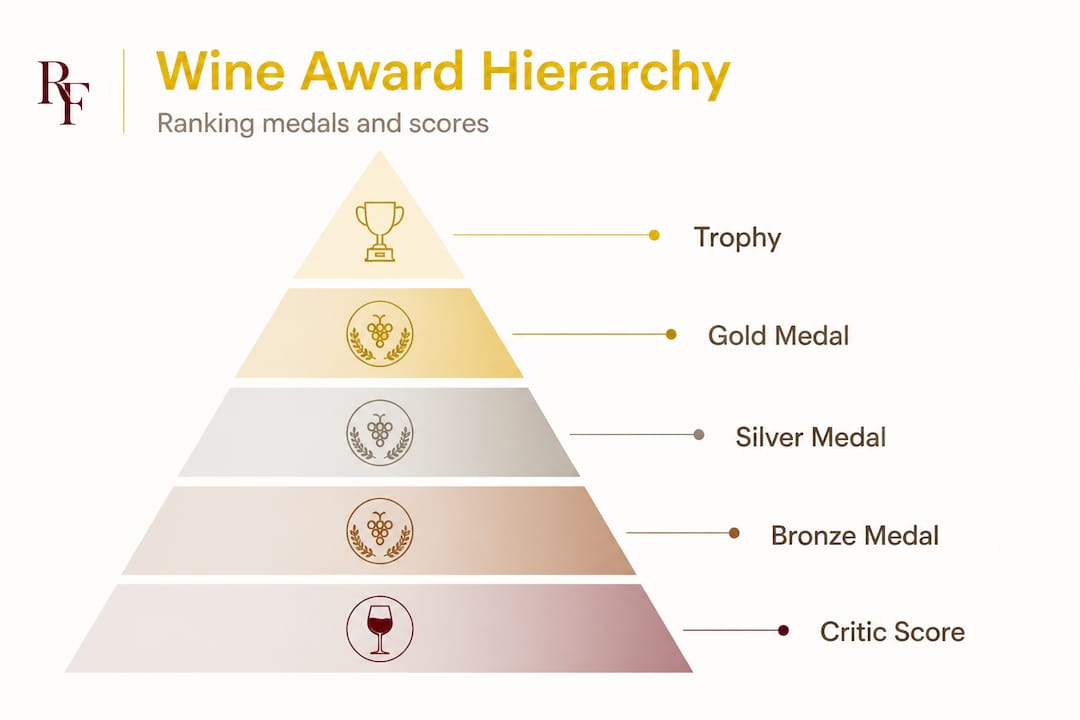
| Award level | What it typically signals | Example competition |
|---|---|---|
| Bronze | Technically sound, good value | Decanter World Wine Awards (DWWA) |
| Silver | Distinctly good, above average | International Wine Challenge (IWC) |
| Gold | Excellent quality, recommended | Mundus Vini, DWWA |
| Platinum / Trophy | Outstanding, category-leading | DWWA, Decanter Grand Prix |
| Double Gold | Unanimous gold from all judges | San Francisco Chronicle Wine Competition |
The medal hierarchy sounds straightforward until you examine competition practices more closely. Obscure competitions lack rigour, with some using panels of only three judges tasting over 200 wines per day, raising serious questions about the reliability of their verdicts. The definition of “double gold” alone varies significantly between events; some require unanimous gold scores, others use different thresholds entirely.
It is equally important to recognise what a high-volume bronze from a prestigious event actually represents. A bronze from the DWWA, for instance, carries genuine meaning for entry-level wines precisely because the competition’s rigour is well established. Earning any recognition there signals competence in a very crowded field.
Here is a quick breakdown of what to consider when evaluating any medal:
- Who organised the competition? Established bodies like Decanter, the IWC, and Mundus Vini have transparent judging processes.
- How many wines were judged? Very large competitions can dilute the significance of lower medals.
- Who were the judges? Named, credentialled judges lend far more credibility than anonymous panels.
- How was the wine entered? Some competitions are open entry; others are invitation-only or regionally curated.
Pro Tip: When you see a medal on a bottle, search for the awarding competition’s name online. A thirty-second check will tell you whether it is a widely respected event or a minor regional contest with limited judging rigour.
The award-winning white blends from the Roussillon region, for example, have earned recognition at credible outlets precisely because old-vine complexity and terroir-driven character are genuinely difficult attributes to produce. That context adds real depth to understanding what a score or medal means on such a bottle. Pairing that wine with the right dish can also amplify the tasting experience, and exploring wine pairing recipes is a smart companion habit for any collector keen on understanding how a wine performs beyond the glass.
Why scores vary: Understanding critics and palate bias
Here is something that surprises many enthusiasts: the same wine tasted by two respected critics can receive scores that differ by 5 to 8 points on the 100-point scale. That gap is not a mistake. It reflects genuine differences in palate, preference, and tasting context.

The clustering effect is equally important to understand. Published scores rarely fall below 85 in major outlets. This is not because all submitted wines are excellent; it is because critics and publications overwhelmingly choose to publish only scores for wines they consider worth recommending. Negative reviews are rare. This creates a compressed scoring landscape where the entire range of “recommended” wine sits between roughly 85 and 100.
| Score range | Common interpretation | What it really signals |
|---|---|---|
| 85 to 87 | Good, recommended | Technically sound, drinkable |
| 88 to 90 | Very good | Genuinely enjoyable, above average |
| 91 to 93 | Excellent | Noteworthy quality and character |
| 94 to 96 | Outstanding | Exceptional, highly collectible |
| 97 to 100 | Classic / perfect | Extremely rare, often historic |
Palate bias is real and unavoidable. A critic who grew up drinking bold, tannic Californian Cabernet may instinctively favour powerful, structured wines. One with a background in Burgundy may give higher marks to subtlety and mineral restraint. Neither is wrong; they are simply different lenses.
“There is no universal meaning for a score of 90. What makes a wine a 90 for one critic may only be an 87 for another, and both judgements can be entirely defensible.” This is why understanding the critic behind the number matters as much as the number itself.
The impact of terroir on scores is also a significant but often underappreciated factor. Wines from distinctive, high-altitude, or climatically complex sites often show flavours that challenge critics accustomed to more conventional expressions. A wine grown at the foothills of the Pyrenees, shaped by schist soils and fierce tramontane winds, will taste unlike anything from Bordeaux or Napa. A critic unfamiliar with that terroir may score it lower simply due to unfamiliarity rather than any deficiency in the wine itself.
When and why accolades matter most
Knowing when to trust accolades and when to look elsewhere is where this knowledge becomes genuinely actionable.
- Unfamiliar entry-level wines: Accolades are most useful for entry-level wines priced below around £20. When you know nothing about a producer and cannot taste before buying, a medal from a credible competition provides a meaningful shortcut.
- Gift buying: Awards give gift-buyers confidence when purchasing for someone whose palate they do not know intimately. A gold medal simplifies a difficult choice.
- Retail browsing: In supermarkets and large off-licences where staff expertise is limited, an award sticker acts as a basic quality filter among unfamiliar labels.
- Exploring new regions: When venturing into a wine region you have little experience with, competition results from events that specifically focus on that region can be a useful initial guide.
- Tracking producer consistency: If a producer earns medals across multiple vintages from the same competition, that pattern is far more meaningful than a single award.
Pro Tip: For award-winning reds priced above £25 to £30, move beyond medals and seek out named critic reviews with tasting notes. The narrative context a skilled critic provides tells you far more about whether a wine suits your palate than a medal category ever can.
For collectors, the calculus shifts significantly. Premium and investment-grade wines are better assessed through the track records of trusted, named critics whose palate preferences you have come to understand over time. A rotating anonymous panel simply cannot offer that level of reliable, consistent reference.
Awards also affect market dynamics in measurable ways. A high score or major trophy can increase demand almost overnight, sometimes raising prices by 20 to 40 per cent within weeks of publication. This is useful to know if you want to buy before a release is reviewed, or if you are considering selling from a cellar.
Our take: The uncomfortable truth about wine accolades
We have followed wine accolades closely enough to say this plainly: the medal on a label and the score in a magazine are starting points, not verdicts.
The industry tends to present accolades as objective stamps of quality. In practice, they are snapshots, shaped by who was in the room, what they had tasted previously that day, the temperature of the room, and the mood of the panel. Blind tasting reduces some of these variables, but it does not eliminate them.
For collectors and serious enthusiasts, named critic track records are genuinely more valuable than rotating panel medals. When you follow a critic for years, you learn their biases, their blind spots, and the styles that excite them. A 93 from a critic who consistently underrates your favourite region becomes a very different signal than a 93 from someone whose preferences align closely with your own.
The uncomfortable truth is that awards alone have never been a reliable indicator of investment-quality wine. The bottles that appreciate most in value over decades are typically those tied to a celebrated producer, a renowned vintage, and a strong critic consensus across multiple independent voices. A single trophy rarely moves that needle.
What we believe matters far more is the story behind the wine. How the vines were tended. Whether the winemaker intervened minimally, trusting the site to speak. Whether sustainable vineyard practices inform every decision from pruning to bottling. Those factors shape the wine in the glass far more lastingly than any judging panel can assess in a brief competition pour.
Accolades can be genuinely useful. They just should not be treated as the final word.
Discover renowned award-winning wines
If this guide has sharpened your thinking about what accolades really signal, the natural next step is to taste wines where the recognition is grounded in something real.

Res Fortes crafts wines from the rugged Côtes du Roussillon, recognised by Wine Enthusiast, the drinks business, Fine Vintage, and top Vivino reviewers. Whether you are drawn to the old-vine depth of The Brave, the estate Syrah of Traveller, or the expressive white blends, each bottle carries accolades earned through genuine terroir-driven winemaking. You can shop single bottles or curated mixed cases, join the Elite Member programme for exclusive releases, and enjoy free UK and France shipping on three bottles or more. Explore the award-winning reds and discover why genuine accolades feel so different in the glass.
Frequently asked questions
Do wine medals always indicate top quality?
No, medals can be awarded across a wide range of quality levels, and high-volume bronzes from reputable events are particularly common for entry-level wines, where they signal sound craftsmanship rather than exceptional complexity.
Why do wine scores differ between critics?
Scores differ by 5 to 8 points because each critic brings a unique palate and set of preferences to the tasting table, making a score of 90 from one writer genuinely different from the same number given by another.
Are accolades meaningful for premium wines?
For premium bottles, named critic track records are far more useful than competition medals because collectors can evaluate a critic’s palate over time and assess how their preferences align with their own.
What is a “double gold” medal in wine competitions?
A double gold typically means that every judge on the panel independently awarded a gold score, though the precise definition varies between competitions and should always be verified against the specific event’s judging criteria.
Recommended
- Discover what makes French boutique wineries unique – Res Fortes
- Vineyard sites and their true impact on wine quality – Res Fortes
- Why French white blends excel: Aroma, balance, and discovery – Res Fortes
- Explore the types of rosé wine for every palate – Res Fortes
- What makes a wine collectible? A guide for investors