

What is wine balance? A guide for wine lovers
Wine balance is defined as the harmonious integration of acidity, tannin, alcohol, and residual sweetness, with no single element dominating the tasting experience. This concept sits at the heart of wine quality assessment and is the primary reason some wines feel effortless to drink while others feel sharp, hot, or cloying. The WSET’s BLIC framework (Balance, Length, Intensity, Complexity) places balance as the first and most critical criterion for rating a wine as outstanding. Understanding what wine balance means, and how to detect it, transforms the way you taste and choose wine.
What components make up wine balance?
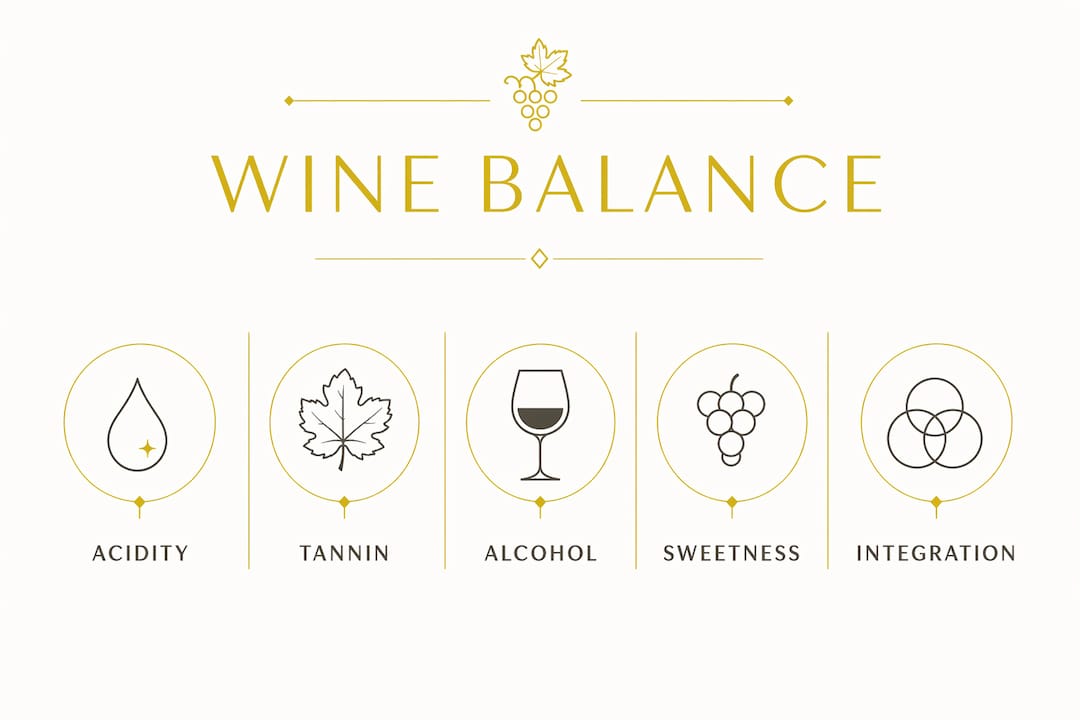
Wine balance requires four structural elements to work in concert: acidity, tannin, alcohol, and residual sweetness. Each plays a distinct sensory role, and each can tip the experience into unpleasantness when it outpaces the others.
Acidity provides freshness, lift, and the sensation of saliva forming at the sides of your mouth. It also acts as a natural preservative, which is why high-acid wines age well. Without enough acidity, a wine tastes flat and dull. Too much, and it tastes sharp or sour, like biting into an unripe lemon.
Tannins are the dry, grippy sensation you feel across your gums and the inside of your cheeks, most prominent in red wines such as Cabernet Sauvignon or Nebbiolo. They add structure and the capacity to age, but harsh tannins in a wine with insufficient fruit or body create an astringent, sandpaper-like finish that few people enjoy.
Alcohol contributes body, warmth, and texture. A wine at 14.5% ABV with good fruit concentration can feel perfectly integrated. The same alcohol level in a lean, low-fruit wine produces a burning sensation at the back of the throat, which tasters describe as “hot.”
Residual sweetness rounds out mouthfeel and softens the perception of acidity. This is why a German Riesling Spätlese with 8% alcohol and noticeable sweetness can feel perfectly poised: the acidity and sugar counterbalance each other precisely. When sweetness exceeds what the acidity can balance, the wine tastes cloying rather than lush.
- Acidity masks sweetness: higher acid makes a wine taste drier than its sugar level suggests
- Tannin and alcohol amplify each other: a high-alcohol wine with firm tannins feels more astringent than either element alone
- Sweetness softens tannin perception, which is why off-dry rosés feel smoother than bone-dry reds at the same tannin level
- Fruit concentration acts as the backdrop against which all four elements are measured
Pro Tip: When you notice something “off” in a wine, try to name which element is dominating. Is it sharp (excess acidity)? Hot (excess alcohol)? Grippy (excess tannin)? Cloying (excess sweetness)? Naming the culprit sharpens your palate faster than any other exercise.
How can you evaluate wine balance on the palate?
Evaluating balance is not a single moment of judgement. It is a process that unfolds across three tasting phases: the attack, the mid-palate, and the finish. Each phase reveals whether the wine’s components are integrating or competing.
- Attack: The first impression as wine enters your mouth. Note which element hits first and how forcefully. A well-balanced wine presents its components together rather than leading with a single aggressive note.
- Mid-palate: As the wine spreads across your tongue, assess whether the texture is consistent. Does the fruit hold up? Does acidity spike or tannin suddenly grip? Inconsistency here signals structural tension.
- Finish: The sensations that remain after swallowing. A long finish of 10 to 15 seconds or more, where flavours persist harmoniously, is a reliable indicator of good balance. A short or abrupt finish suggests one element has overwhelmed the others and then disappeared.
- Cohesiveness check: Ask yourself whether the wine felt like one thing or several competing things. Balance produces a sense of unity. Imbalance produces the sensation of tasting components rather than a wine.
- Texture and persistence: A balanced wine maintains consistent texture from attack to finish. If the mouthfeel changes dramatically, or if a harsh tannin or hot alcohol sensation appears only at the end, the wine is structurally unresolved.
A common novice mistake is to judge balance by sweetness or alcohol alone, without considering how texture, integration, and finish length interact. A wine can be sweet and balanced, or dry and imbalanced. The relationship between components matters far more than any single reading.
Pro Tip: Taste the wine twice: once immediately after pouring, and once after it has been in the glass for ten minutes. Imbalanced wines often reveal their flaws more clearly with a little air. Balanced wines tend to open up and improve.
What role does wine balance play in quality assessment?
Balance is the foundation upon which all other quality markers depend. WSET’s SAT framework ranks balance as the primary criterion in its BLIC quality assessment, above length, intensity, and complexity. A wine with extraordinary complexity but poor balance still rates lower than a simpler wine where every element integrates cleanly.
Research published in 2026 confirmed that consumer liking depends more on attribute interactions than on any single component such as sweetness or tannin. High alcohol combined with low sweetness or acidity amplifies bitterness and reduces enjoyment. This means that a wine with 15% ABV is not inherently problematic, but the same wine without sufficient fruit, acidity, or sweetness to counterbalance the alcohol will consistently score lower in consumer preference studies.
| Quality marker | How balance affects it |
|---|---|
| Ageing potential | Balanced acidity and tannin preserve wine and allow it to develop over time |
| Food compatibility | Balanced wines adapt to a wider range of dishes without clashing |
| Drinkability | Integration of components removes friction, making the wine easier to enjoy |
| Professional scoring | WSET and similar frameworks rate balance as the primary quality criterion |
“Without integration, a wine may feel disjointed even if individual elements are pleasant.” — WineWiki on Balance
Balance also determines when a wine is ready to drink. A young Barolo with firm tannins and high acidity may be technically imbalanced now, but cellaring allows the tannins to soften and integrate with the fruit. Knowing this helps you decide whether to open a bottle today or give it five more years.
Are balanced wines always preferable?
The short answer is no. Wine writer Jamie Goode has argued that strict pursuit of balance risks producing wines that are technically correct but personality-free. Some of the most memorable wines in the world are memorable precisely because they push one element to an extreme.
Consider these examples of intentional stylistic imbalance that drinkers value:
- Portuguese Vinhão reds carry high acidity and a green, almost aggressive character that pairs brilliantly with the fatty richness of local cuisine. Tasted alone, they feel unbalanced. At the table, they are perfect.
- Fino Sherry is searingly dry and high in acidity by most standards, yet this is exactly what makes it one of the world’s great aperitif wines.
- Amarone della Valpolicella is deliberately high in alcohol, often reaching 16 to 17% ABV, with concentrated dried-fruit sweetness that counterbalances the heat. It is not a textbook balanced wine, but it is a profound one.
- Natural wines from producers working with minimal intervention sometimes display volatile acidity or slight effervescence that breaks classical balance rules, yet attract devoted followings for their authenticity and sense of place.
The risk of treating balance as an absolute standard is stylistic homogeneity. If every winemaker optimises for the same textbook integration, the world loses the regional and varietal diversity that makes wine worth exploring. Balance is a guide, not a law.
How do winemaking techniques shape a wine’s balance?
Balance is not only a product of the vineyard. Cellar decisions made after harvest have a profound influence on how the final wine feels in the glass. Understanding these techniques helps you read a wine’s character more accurately.
Malolactic fermentation (MLF) converts sharp malic acid into softer lactic acid, reducing perceived acidity and smoothing tannins. Most red wines undergo MLF to improve mouthfeel, while aromatic whites such as Riesling and Sauvignon Blanc typically avoid it to preserve freshness and structural tension. Burgundian Chardonnay, by contrast, almost always undergoes MLF, which is a key reason it feels rounder and creamier than its Alsatian counterparts.
Oak ageing adds tannin, vanilla, and spice, and can contribute to structural complexity. The risk is overdoing it. A wine aged in 100% new French oak for 24 months can emerge with wood tannins that overwhelm the fruit, producing a wine that tastes of the barrel rather than the grape. Skilled winemakers calibrate oak exposure to add structure without dominating the fruit.
Blending is one of the most powerful tools for achieving balance. By combining grape varieties or parcels with complementary attributes, a winemaker can correct deficiencies that no single component could resolve alone. Grenache brings alcohol and red fruit; Syrah adds colour, tannin, and pepper; Mourvèdre contributes structure and longevity. Together, as in a classic Grenache-Mourvèdre-Syrah blend, they produce a wine more balanced than any variety could achieve individually. Resfortes’ wine blending approach reflects exactly this philosophy, combining varieties from the Côtes du Roussillon to achieve harmony across the range.
| Technique | Effect on balance |
|---|---|
| Malolactic fermentation | Softens acidity, smooths tannins, adds creaminess |
| Oak ageing | Adds tannin and structure; risks imbalance if overdone |
| Blending | Combines complementary attributes to correct individual deficiencies |
| Chaptalization | Raises alcohol; can tip balance if fruit concentration is insufficient |
Key takeaways
Wine balance is the integration of acidity, tannin, alcohol, and sweetness, and it governs how every other quality in a wine is perceived and enjoyed.
| Point | Details |
|---|---|
| Balance defined | Harmonious integration of acidity, tannin, alcohol, and sweetness with no single element dominating |
| WSET BLIC framework | Balance is the primary quality criterion, ranked above length, intensity, and complexity |
| Evaluation method | Taste across attack, mid-palate, and finish; a long, cohesive finish confirms structural balance |
| Consumer preference | Research shows liking depends on component interactions, not any single factor like sweetness or tannin |
| Stylistic nuance | Not all great wines are classically balanced; intentional imbalance can reflect authenticity and regional character |
Why balance is the most useful concept in wine, but not the only one
I have spent years tasting wines from across France, Spain, and beyond, and balance remains the single most useful concept for explaining why one wine feels effortless and another feels like work. When I hand someone a glass of Resfortes’ The Brave and they say “I don’t know why, but I just want another sip,” what they are responding to is balance. The old-vine Grenache, the terroir of the Pyrenean foothills, the minimal-intervention winemaking: all of it converges into a wine where nothing jars.
But I have also learned to be suspicious of balance as a rigid standard. Some of the wines that have stayed with me longest were not balanced in any textbook sense. A Jura Savagnin with oxidative sharpness. A Madeira with acidity that could strip paint. These wines broke the rules and were extraordinary for it. The WSET framework is a tool for building vocabulary and consistency, not a verdict on whether a wine is worth drinking.
My advice to anyone learning to taste: use balance as your primary diagnostic. Train yourself to identify which component is dominating and why. Once you can do that reliably, you will have the vocabulary to appreciate both the wines that follow the rules and the ones that gleefully ignore them. The structural components in your glass are always telling you something. Balance just teaches you how to listen.
— Moritz
Discover expertly balanced wines from Resfortes
Resfortes crafts wines from the Côtes du Roussillon that demonstrate what genuine balance looks like in practice, from the citrus-laced Rosé to the flagship The Brave, praised by Wine Enthusiast and the drinks business for its old-vine Grenache at its most expressive. Every bottle in the range reflects thoughtful vineyard selection and minimal-intervention winemaking designed to let the components of each wine find their own equilibrium.
Whether you are building your palate or adding to a serious cellar, the full Resfortes range offers a practical way to taste balance across different styles, from the fresh acidity of the white blends to the structured depth of the Syrah Traveller. Free shipping applies on three bottles or more across the UK and France.
FAQ
What is wine balance in simple terms?
Wine balance means that acidity, tannin, alcohol, and sweetness work together without any one element standing out uncomfortably. A balanced wine feels harmonious from the first sip to the finish.
What are the main components that affect wine balance?
The four structural components are acidity, tannin, alcohol, and residual sweetness. Each counterbalances the others, so a change in one element shifts how the rest are perceived.
How do you know if a wine is balanced?
Taste through the attack, mid-palate, and finish. A long, cohesive finish of 10 to 15 seconds or more, where no single element dominates, is the clearest sign of structural balance.
Does a balanced wine always taste better?
Not necessarily. Research confirms that component interactions govern liking more than classical balance alone, and some wines are intentionally styled with dominant acidity or alcohol that suits specific occasions or cuisines.
How does winemaking influence balance?
Malolactic fermentation softens acidity, oak ageing adds tannin, and blending combines complementary grape varieties to correct imbalances that no single variety could resolve on its own.