
Port-Vendres is a working Mediterranean fishing port and one of the South of France’s most genuinely unspoilt coastal towns. Tucked between Collioure and Banyuls-sur-Mer on the southernmost stretch of the French coast, it serves as the natural gateway to the Côte Vermeille wine region, where steep, terraced vineyards of Grenache and Syrah tumble down to the sea. Unlike its more famous neighbours, this town has resisted the full pull of mass tourism. The harbour still smells of salt and diesel. The fish auctions still start before most visitors are awake. That is exactly the point.
What makes Port-Vendres worth visiting?
Port-Vendres is defined by its working port identity, and that sets it apart from every polished resort town along this coastline. The harbour handles serious commercial traffic. The town lands around 6,000 tonnes of bananas weekly, making it France’s leading banana port. That scale of activity gives the town a pulse that purely tourist destinations simply cannot replicate.
The marina holds Blue Flag certification with 254 mooring rings and handles around 2,000 vessel calls per year. Blue Flag status signals clean water and well-managed facilities, which matters if you plan to sail in or take a boat trip. The mix of working trawlers and leisure craft creates a harbour scene that feels genuinely alive rather than staged.
Visiting off-peak brings real rewards. Shoulder seasons, particularly april through june and september through october, offer the port at its most atmospheric. Crowds thin, prices drop, and the town’s natural rhythms become far easier to observe and appreciate.
What are the must-see attractions in Port-Vendres?
The town’s historical layers are visible at every turn. A tall obelisk in the main square was erected in honour of Louis XVI, commemorating the port’s role as a royal naval base. The surrounding fortifications, many dating to the 17th and 18th centuries, reflect the strategic importance this harbour once held along the Franco-Spanish border.

The daily fish auction is one of the most authentic experiences on the entire Côte Vermeille. It takes place at the quayside in the early morning, when the night’s catch is unloaded and sold to local buyers. Watching this process gives you a direct window into the port’s working soul. Most visitors to the South of France never see anything like it.

A short drive from the town centre, the Anse de Paulilles is a 32-hectare protected site that was once Alfred Nobel’s dynamite factory. Today it is a natural and historical sanctuary combining conservation with heritage. The contrast between its industrial past and its current tranquillity is striking.
Key landmarks at a glance:
- The Louis XVI obelisk in the central square, a rare piece of royalist public art in republican France
- The quayside fish auction, best observed in the early morning
- Anse de Paulilles, the former Nobel dynamite factory turned protected nature reserve
- Cap Béar lighthouse, perched on the headland with sweeping views across the Gulf of Lion
- Fort Béar and the coastal fortifications, remnants of centuries of military history
Pro Tip: Arrive at the quayside by 7am to catch the fish auction in full swing. It is free to observe and unlike anything you will find in a guidebook.
What outdoor activities can visitors enjoy around Port-Vendres?
The natural setting here is exceptional. The Pyrenees meet the Mediterranean in a collision of schist rock, wild scrubland, and deep blue water. That geography creates outstanding conditions for hiking, sailing, and wildlife watching.
-
Dolphin watching on the Gulf of Lion. Specialised 5-hour tours depart from Port-Vendres during summer months, heading into the Gulf of Lion Marine Natural Park. Departures typically start at 11:30am. Bottlenose dolphins are the main attraction, and sightings are frequent in calm conditions.
-
Hiking to Cap Béar lighthouse. The 4.2 km trail from the tourist office to Cap Béar lighthouse takes roughly 45 minutes at a moderate pace. The path follows the clifftop with uninterrupted sea views. It is rated intermediate difficulty, so a reasonable level of fitness is needed.
-
The Petit Train Touristique. This tourist train runs a 45-minute circuit through the surrounding vineyards and up to Fort St. Elme. It is a relaxed way to take in the landscape without the effort of a hike, and the commentary gives useful context about the local wine culture.
-
Swimming at Anse de Paulilles. The best swimming spots lie outside the port itself. Anse de Paulilles offers calm, clear water in a sheltered bay, accessible by a short drive or coastal walk from the town centre.
-
Slow catamaran tours. Low-impact boat tours follow the rugged coastline at a pace that respects marine life. These trips highlight the port’s working character and the dramatic schist cliffs that define the Côte Vermeille.
Pro Tip: Book dolphin watching tours at least a week ahead in july and august. Spaces fill quickly and the tours do not run in rough weather.
How does Port-Vendres connect to the Côte Vermeille wine region?
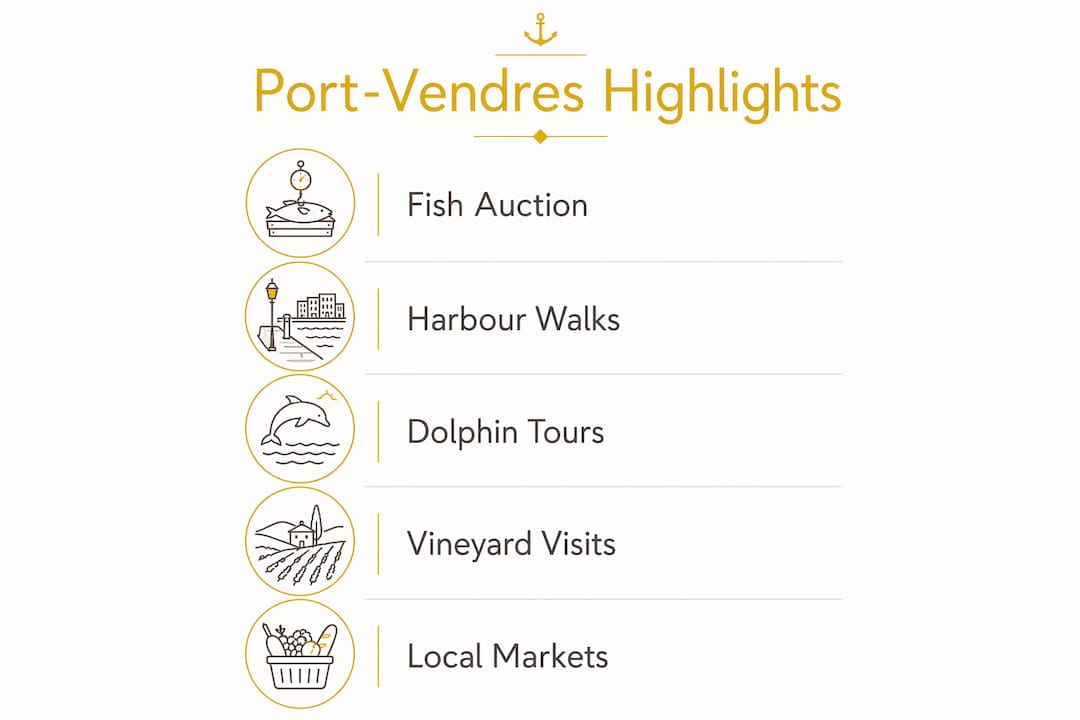
The vineyards here are unlike anything on the Roussillon plains. The terraced, steep plots around Port-Vendres grow old vines of Grenache and Syrah on schist soils, producing wines with a mineral intensity and saline edge that reflects the proximity of the sea. This terroir is genuinely distinct from the broader Roussillon appellation. Understanding that difference is the starting point for any serious wine exploration in the area.
The Route des Vins along the Côte Vermeille connects Port-Vendres with Collioure and Banyuls-sur-Mer, forming a compact wine trail that can be covered in a day. Collioure produces expressive reds and rosés. Banyuls-sur-Mer is famous for its fortified Banyuls wine, a naturally sweet wine made from Grenache. Port-Vendres sits between the two, making it an ideal base for exploring both appellations.
| Wine style | Key grape | Flavour profile |
|---|---|---|
| Côte Vermeille red | Grenache, Syrah | Dark fruit, garrigue, mineral finish |
| Collioure rosé | Grenache, Mourvèdre | Citrus, dried herbs, saline edge |
| Banyuls (fortified) | Grenache | Dried fig, cocoa, oxidative notes |
| Côtes du Roussillon white | Grenache Blanc, Roussanne | Stone fruit, floral, textured |
Producers in the area tend to work in small volumes with minimal intervention in the cellar. Visiting a grower directly, rather than a commercial cave, gives you access to wines that rarely leave the region. Pair a Collioure red with grilled sardines or a plate of anchovies from the port. The match is instinctive and historically grounded.
For a deeper understanding of how these Roussillon terroir nuances translate into the glass, the distinctions between schist soils and the broader appellation become clear very quickly.
What are the best dining options in Port-Vendres?
The food in Port-Vendres is shaped entirely by what the boats bring in. Freshness is not a marketing claim here. It is a structural reality. The fish on your plate at lunch was likely auctioned at the quayside that morning.
Key dishes and dining experiences to seek out:
- Grilled sea bass or bream cooked simply over charcoal, served with local olive oil and herbs. The quality of the fish makes elaborate preparation unnecessary.
- Shellfish platters featuring mussels, oysters, and sea urchins, best eaten at a harbour-view table with a cold Collioure rosé.
- Catalan dishes such as pa amb tomàquet (bread rubbed with tomato and olive oil) and escalivada (roasted aubergine and peppers), which reflect the town’s position on the French-Catalan cultural border.
- Anchovies from Collioure, a regional speciality with protected status. They are saltier and more intensely flavoured than tinned anchovies from elsewhere. Buy a jar to take home.
- Harbour-front restaurants along the quai Pierre Forgas offer the best combination of fresh catch and atmosphere. Booking ahead is advisable from june through september.
The town also has a weekly market where local producers sell fruit, vegetables, cheese, and charcuterie. Combining a market visit with a harbour lunch is the most satisfying way to spend a morning here.
What practical tips should travellers know before visiting Port-Vendres?
Getting the logistics right makes a significant difference to how much you enjoy the town. Parking is genuinely difficult during peak summer. The streets are narrow, spaces are limited, and arriving after 9am in july or august often means a long walk from wherever you eventually find a spot.
Practical advice for a smooth visit:
- Arrive early. Before 8:30am in summer, parking near the harbour is manageable. After that, it becomes a frustration.
- Use the bus. Regional buses connect Port-Vendres with Collioure and Banyuls-sur-Mer. The service is reliable and removes the parking problem entirely.
- Take the train to Perpignan first. The nearest major rail hub is Perpignan, roughly 30 km north. From there, regional trains and buses reach the Côte Vermeille towns with ease.
- Visit in shoulder season. April through june and september through october offer the best balance of good weather, open restaurants, and manageable crowds.
- Plan a two-day itinerary. One day for the port, the fish auction, and Cap Béar. A second day for the wine trail through Collioure and Banyuls-sur-Mer.
Pro Tip: The tourist office on the quayside stocks free hiking maps for the Cap Béar trail and can advise on which producers are open for tastings on any given day.
Key takeaways
Port-Vendres rewards travellers who prioritise authenticity over convenience, combining working port heritage, outstanding coastal hiking, and some of the most distinctive wine terroir in southern France.
| Point | Details |
|---|---|
| Authentic port atmosphere | Early morning fish auctions and active harbour life set Port-Vendres apart from resort towns. |
| Best outdoor activity | The 4.2 km Cap Béar lighthouse hike offers the most rewarding coastal views with moderate effort. |
| Wine exploration base | Port-Vendres sits between Collioure and Banyuls-sur-Mer, making it ideal for the Côte Vermeille wine trail. |
| Practical travel tip | Arrive before 8:30am in summer or use regional buses from Collioure to avoid parking difficulties. |
| Best swimming spot | Anse de Paulilles, the former Nobel dynamite factory site, offers the clearest and calmest water near the town. |
Why Port-Vendres is the Côte Vermeille visit most travellers miss
I have spent time along this coastline across different seasons, and Port-Vendres consistently surprises me. Not because it is undiscovered, but because it refuses to perform for tourists. The fish auction does not pause for photographs. The growers do not keep polished tasting rooms. The town simply gets on with being itself, and that is rarer than it sounds on the French Mediterranean coast.
What I find most valuable here is the wine culture. The schist vineyards above the port produce Grenache with a saline, mineral character that you genuinely cannot find anywhere else in France. Most visitors to Roussillon never make it past the plains appellations. The Côte Vermeille growers working these steep terraces are producing some of the most interesting wines in the country, and they are largely doing it without the attention they deserve.
My honest advice: skip one night in Collioure and spend it here instead. Walk to Cap Béar at dusk. Find a table at the harbour with a bottle of local red. Talk to the person running the boat tours. The southern French wine culture that makes this region so compelling is most legible when you are sitting inside it, not reading about it from a terrace in a busier town.
Port-Vendres is not a compromise. It is the real thing.
— Moritz
Res Fortes wines: the taste of Côte Vermeille terroir in a bottle
The steep schist vineyards and old-vine Grenache that define the Côte Vermeille are the same forces that shape Resfortes’ award-winning wines from the Côtes du Roussillon.
Res Fortes crafts its range, from the old-vine Grenache flagship The Brave to the estate Syrah Traveller, with the same minimal-intervention philosophy that the best Côte Vermeille producers follow. Each bottle reflects the rugged terroir at the foothills of the Pyrenees that you experience when you stand above Port-Vendres looking out to sea. Wine Enthusiast, the drinks business, and Fine Vintage have all recognised the quality. Browse the full Res Fortes wine collection and bring a piece of this coastline home with you.
Recommended
What is Port-Vendres best known for?
Port-Vendres is France’s leading banana port and a working Mediterranean fishing harbour. It is also the gateway to the Côte Vermeille wine region, known for its steep Grenache and Syrah vineyards.
When is the best time to visit Port-Vendres?
Shoulder seasons, particularly april through june and september through october, offer the most authentic experience with fewer crowds and easier parking. Summer is lively but logistically demanding.
How do I get to Port-Vendres without a car?
Regional buses connect Port-Vendres with Collioure and Banyuls-sur-Mer. The nearest major rail hub is Perpignan, from which regional services reach the Côte Vermeille towns.
What wine should I try near Port-Vendres?
Collioure reds and rosés made from Grenache and Syrah are the local benchmark. Banyuls fortified wine, a naturally sweet Grenache, is the other essential regional style.
Is there good swimming near Port-Vendres?
The best swimming is at Anse de Paulilles, a protected 32-hectare bay a short drive from the town centre. The port itself is not suited to swimming due to commercial vessel traffic.