

Buy wine direct online UK with digital ID, free shipping on 3 bottles
Buy from reputable UK online merchants with clear delivery terms, or go straight to a producer such as Res Fortes for stronger provenance and access to small-batch releases. Before ordering, check three things: delivery terms and returns policy, age verification at checkout, and whether you want a one-off order or a membership. Get those right and the rest of the buying decision falls into place.
TL;DR:
- Reputable UK online wine shops should offer clear delivery terms, detailed tasting notes, expert picks, and filters by grape, region, or style to assist confident buying.
- Always verify retailer policies on packaging, delivery times, and returns, especially for longer transit areas like Northern Ireland or islands, and consider ordering a small trial case first.
- Buying directly from producers like Res Fortes provides stronger provenance, transparent vineyard details, and often includes free UK shipping on orders of three or more bottles.
- Digital age verification for alcohol sales is now allowed in England and Wales using approved online services, but consumers should set up accounts early and keep physical ID as a backup.
- Most trusted retailers accept secure payment methods such as credit/debit cards and digital wallets, with HTTPS security, and avoid dealing with vendors that only support wire transfers or cryptocurrency.
What do reputable online wine shops UK sites actually offer?
The best online wine shops UK buyers return to again and again tend to share the same backbone: a range organised in more than one way, and enough detail to buy with confidence rather than guesswork. Most sites let you browse by country, grape variety, or style (think “crisp and citrusy” versus “bold and structured”), and the good ones layer tasting notes and expert picks on top so you are not choosing blind.
Look for these organisational cues when you land on a new site:
- Filters by grape, region, vintage and ABV, so you can narrow hundreds of bottles to a shortlist in seconds
- Specialist sections for fine wine, en primeur (wine sold before bottling) and gifting, which signal a merchant serious about depth rather than just volume
- Food-matching suggestions or tasting notes written by someone who has actually opened the bottle, not generic marketing copy
- Expert or sommelier picks, separate from paid promotions, that reward browsing rather than just searching
A shop with thin categorisation and no tasting notes is usually a shop reselling stock it does not know well. Trade coverage on buying wine online consistently points buyers towards retailers who invest in this kind of detail, precisely because it separates considered merchants from bulk resellers.
Delivery, packaging and returns: what to check before you order
Delivery is where good intentions meet reality. Most reputable UK online wine retailers offer free delivery above a certain bottle quantity threshold, and use a mix of their own van fleets for local areas and national parcel networks for everywhere else. The Wine Society, for example, runs next-day delivery if you order before midday on a weekday, with named delivery slots and carrier tracking, a level of transparency worth using as your own benchmark.
Follow these steps if a delivery goes wrong:
- Photograph the damaged packaging and bottles before you touch or discard anything.
- Keep the original box and inserts, since some retailers require proof of packaging quality for their claim.
- Contact the retailer within 48 hours, quoting your order number and attaching photos.
- Ask for their stated refund or replacement timeline in writing rather than relying on a verbal promise.
Returns on UK ecommerce orders are generally straightforward for damaged goods, though timeframes vary by retailer rather than following one fixed rule. If you live in Northern Ireland or on an island, expect longer transit times and check whether the retailer surcharges or excludes these postcodes altogether before you order.
Pro Tip: Order a small trial case before committing to a large order with a new merchant. It tells you more about their packaging standards than any review ever will.
Single bottles, mixed cases or a subscription: which suits you?
Your buying pattern should follow your reason for buying, not the other way round. A one-off bottle makes sense for trying something new or a specific dinner. Mixed cases earn their keep when you are stocking up for an event, buying gifts, or simply want variety at a lower per-bottle cost than buying six of the same wine.
Subscription wine clubs promise curated discovery, but the value depends entirely on the fine print:
- Check the frequency (monthly versus bimonthly) against how quickly you actually drink through a case
- Read the substitution policy, since some clubs swap wines without much notice if stock runs low
- Confirm the cancellation terms before you join, not after your second charge lands
- Ask whether “exclusive” releases are genuinely limited or simply relabelled stock
Buying direct from a producer sits apart from both models. Some producers sell single bottles and curated mixed cases alongside a subscription program, which can give a clearer line of sight to how the wine was made and who made it than a multi-brand retailer can usually offer. That direct relationship matters more than it sounds. When you buy through a producer, there is no intermediary rebranding or repackaging between the vineyard and your door.
Does UK law now allow digital age verification for wine?
Yes. New rules permit licensed premises in England and Wales to accept approved digital verification services (DVS) as an alternative to a physical passport or driving licence when age-checking alcohol sales. The government’s announcement confirms that any DVS used must meet at least a medium level of confidence under the DVS trust framework, and adoption by individual businesses is entirely optional.
That optionality matters for online wine buyers. Retailers must contract with a registered digital verification service provider, update their age-verification policies, and train staff before they can accept digital ID, according to progress updates from the relevant government blog. Larger retailers with established checkout infrastructure are likely to move first, while smaller independents may take longer.
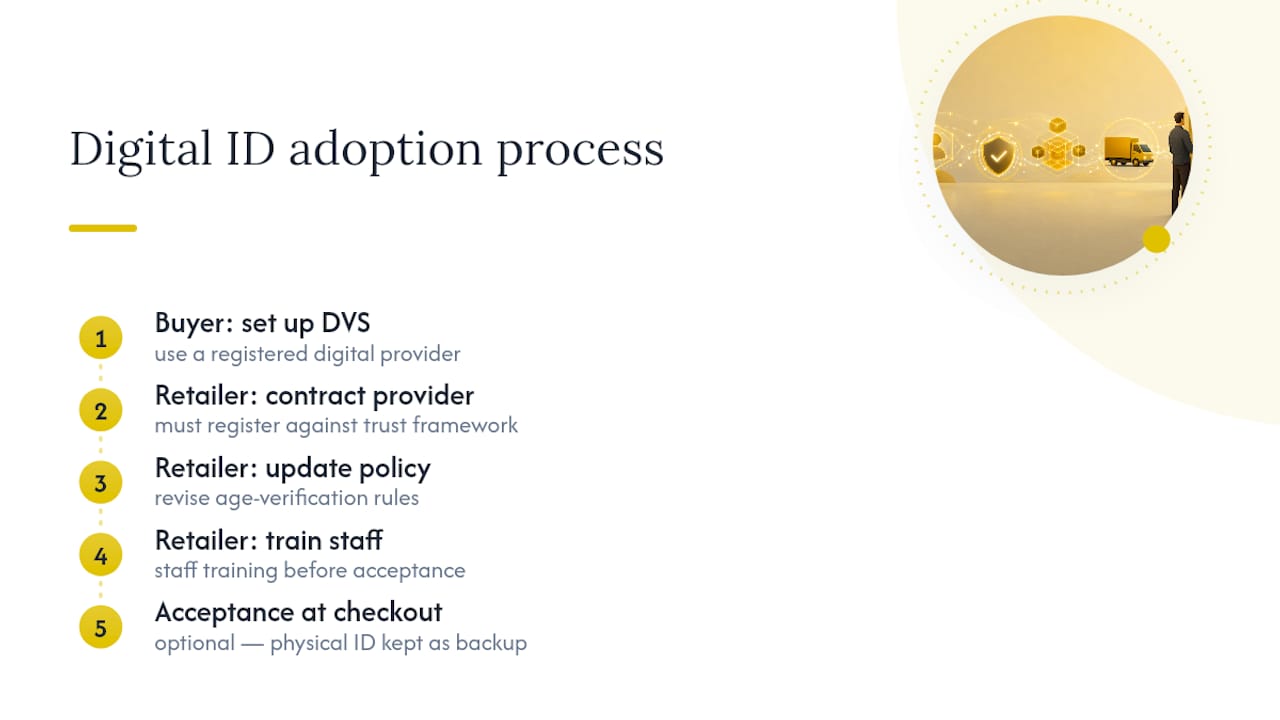
The statutory detail sits in the amendment to the Licensing Act’s mandatory conditions, which specifies that any accepted DVS provider must be registered against the current trust framework version.
In short: if you expect to use digital ID, set one up with a registered provider in advance and always keep a physical ID as a backup, since not every online wine shop will accept DVS on day one.
How do you choose a reputable online wine shop?
A methodical check before you commit to a new retailer saves you far more hassle than any discount code.
- Confirm the delivery carrier and timescale stated at checkout, not buried in a help page.
- Read the returns policy in full, specifically what happens with damaged or corked bottles.
- Check that pricing includes VAT and shipping costs upfront, with no surprise fees at the final step.
- Test the contact channels before you buy: email a genuine question and time how long the reply takes.
- Look for provenance detail, tasting notes and vintage information rather than vague “premium wine” copy.
- Scan recent customer reviews on an independent platform, not just testimonials on the retailer’s own site.
Before placing a large or first-time order, ask customer service directly how they pack multi-bottle orders, what happens if a bottle arrives corked, and whether they can confirm current stock rather than relying on a website that has not been updated.
Pro Tip: A retailer with no phone number, no named contact, and only a contact form is a red flag worth taking seriously, especially for orders above a few dozen pounds.
Watch for retailers with a pattern of unanswered complaints about broken bottles on independent review platforms; a handful of one-off issues is normal, a recurring theme is not.
What payment methods do UK wine retailers accept, and are they secure?
Most established online wine shops UK buyers use accept debit and credit cards, along with digital wallets such as Apple Pay and Google Pay, and a growing number now support account-to-account payment options at checkout. Producers selling directly, including Res Fortes, typically let you check out in either GBP or EUR, which matters if you are comparing prices against a French producer’s own site.
Security should be visible, not assumed. A legitimate retailer’s checkout runs over HTTPS (look for the padlock in your browser bar) and processes card payments through a recognised gateway rather than asking you to email card details or transfer money directly to a personal account. Card payments also give you Section 75 protection under the Consumer Credit Act for purchases over £100, which is one of the strongest practical reasons to avoid bank transfers for wine orders of any size.
Be cautious of any wine retailer that only accepts direct bank transfer or cryptocurrency, particularly for a first order. That payment pattern is far more common among short-lived resellers than established merchants with a genuine trading history. If a deal looks unusually cheap and the payment options look unusually limited, treat that combination as your cue to check the retailer’s company registration and reviews before parting with any money.
Subscription and membership schemes add one more consideration: confirm how your card is stored and rebilled, and whether you can update or remove payment details without contacting support directly.
Are loyalty schemes worth it, and how do they compare?
Loyalty and membership schemes vary enormously between UK wine retailers, and the differences matter more than the marketing suggests. Some offer straightforward points-per-pound schemes redeemable against future orders. Others bundle in tangible perks: early access to limited releases, invitations to tastings, or discounted delivery once you cross a spend threshold.
Producer-run membership, by contrast, tends to centre on access rather than points. Res Fortes’ Elite Member programme, for example, is built around exclusive releases rather than a discount ladder, which suits a buyer who wants first access to a specific old-vine Grenache over one chasing the lowest possible price per bottle.
When comparing schemes, weigh up:
- Whether rewards are cash-equivalent (points off future orders) or access-based (early releases, events)
- The cancellation and pause terms, particularly for wine clubs charging monthly
- Whether “member pricing” is a genuine discount or simply the standard retail price disguised as a saving
- How exclusive the exclusive releases actually are, versus wines also sold to non-members later
A loyalty scheme is only worth joining if its actual benefit matches how you drink and buy. If you order twice a year, a points scheme with a long redemption threshold is close to worthless. If you buy monthly and want access to small-batch runs before they sell out, a producer’s direct membership will usually outperform a generic points system.
Do online wine shops buy from producers or distributors?
This is the question that separates a merchant from a producer, and it shapes everything from price to provenance. Most large UK wine retailers buy through distributors and wholesalers, aggregating stock from dozens or hundreds of vineyards across multiple countries. That model delivers breadth: it is how a single site can stock Chilean Malbec, Chablis and English sparkling wine side by side.
Producers selling direct skip that layer entirely. Res Fortes sells the wine it makes in the Côtes du Roussillon, at the foothills of the Pyrenees, without a distributor sitting between the vineyard and your delivery address. That structural difference explains why direct-from-producer buying tends to carry stronger, more specific provenance detail: the seller genuinely knows the vintage, the vineyard block, and the winemaking decisions behind the bottle, because they made those decisions themselves.

Neither model is inherently better for every buyer. A multi-brand retailer suits someone building a varied cellar across regions and styles in a single order. A producer suits someone who has found a wine they trust and wants to go deeper: more vintages, member-only releases, and a direct line to the people making it. If provenance and story matter as much as the liquid in the glass, buying direct closes a gap that a distributor-supplied retailer structurally cannot.
How can you verify a wine’s authenticity and provenance online?
Genuine provenance leaves a paper trail, and a reputable seller will show it without being asked. Start with the label detail: a legitimate wine names its appellation (in France, terms like Côtes du Roussillon are legally protected), its vintage, and often its producer directly on the bottle, not just on the website description.
Cross-check what the retailer tells you against independent sources:
- Search the producer’s name alongside the vintage to see whether independent reviewers (Vivino, trade press, wine competitions) have covered that specific wine
- Look for named awards or accolades tied to a specific bottling, rather than vague “award-winning” language with no competition named
- Check whether tasting notes on the retailer’s site match independent reviews in substance, not just tone
- Be wary of unusually deep discounts on well-known labels, since counterfeit and grey-market bottles cluster around recognisable names, not obscure ones
Direct producer purchase removes much of this guesswork by default, since there is no intermediary between the winemaking decision and the listing you are reading. A retailer sourcing through distributors can still be entirely legitimate, but it is worth asking where their stock originates, particularly for older vintages or unusually rare bottlings, before you commit to a large order.
Why buying direct from a producer often solves the provenance problem
Distributors add breadth to your options, but they also add distance between you and the wine’s actual story. That distance is exactly what disappears when you buy direct.
Res Fortes’ position as a small-batch producer working minimal-intervention methods in the Côtes du Roussillon means every bottle traces back to specific vineyard decisions, not a warehouse pick. Awards from outlets including the drinks business and Wine Enthusiast reinforce that the quality claim holds up under independent scrutiny, not just marketing copy. For a UK buyer, the practical upside is straightforward: free shipping on three bottles or more, checkout available in GBP or EUR, and access to releases that never reach a distributor’s list at all.
— Moritz
Res Fortes: buy French wine direct, without the distributor layer
Some producers give buyers a way to skip the distributor entirely and go straight to the vineyard, where local terrain shapes the bottles. Unlike multi-brand retailers selling others’ stock, some producers sell wine they made themselves, across a range of styles and blends.

You can shop single bottles, build a curated mixed case, or join the Elite Member programme for access to exclusive releases before they sell out. UK orders of three bottles or more ship free, and checkout runs in either GBP or EUR, so there is no currency guesswork at the till. If you want to see the current range or check subscription details, start with our wines or explore the Elite Membership page to see what the next release looks like.
Sources
For the legal detail behind digital age verification, read the government’s DVS announcement and the statutory instrument amending licensing conditions. For buying and delivery guidance, Decanter’s wine buying advice and The Wine Society’s delivery and returns page are both worth bookmarking, alongside independent Trustpilot reviews when vetting a new retailer.
- New rules pave the way for businesses to adopt digital proof of age for alcohol sales
- Progress towards enabling the use of digital verification services for alcohol sales in England and Wales
- Explanatory memorandum to The Licensing Act 2003 (Mandatory Licensing Conditions) (Amendment) Order 2026
- How to buy wine online | Decanter
- Delivery Export And Returns | The Wine Society
FAQ
Where is the best place to buy wine online in the UK?
There is no single best retailer for every buyer. Reputable multi-brand merchants suit those wanting breadth across regions, while producers such as Res Fortes suit buyers who want stronger provenance, curated cases, and direct access to releases.
Can I order wine online and have it delivered to the UK?
Yes, most established retailers and producers deliver across the UK, often with free delivery once you order three bottles or more. Delivery to Northern Ireland and island postcodes can take longer, so check the retailer’s stated timescale before ordering.
What are the best websites to buy wine online?
The strongest sites combine clear delivery terms, transparent returns, genuine tasting notes, and visible provenance detail rather than generic marketing language. Producer-direct sites and established UK merchants with published delivery windows, such as The Wine Society’s model, set a useful benchmark.
Is there an online liquor store in the UK?
The UK has numerous online wine and spirits retailers, ranging from large multi-brand merchants to producers selling direct. All sellers must apply age verification at checkout and on delivery, now including approved digital verification services alongside traditional physical ID checks.
How much does Res Fortes wine cost?
Current prices for single bottles, mixed cases and the Elite Membership subscription are listed on the Res Fortes wine collection page. UK orders of three bottles or more ship free, with checkout available in GBP or EUR.