

Wine blending for sommeliers: Enhance skill and style
Picture this: a guest at your table asks you to explain why two wines made primarily from Grenache taste so fundamentally different, one flat and one electric. You reach for words like “terroir” and “balance,” but you know the real answer lies in the blending decisions made long before the wine reached your cellar. For sommeliers, understanding the craft of assemblage is not optional knowledge. It is the difference between describing what is in the glass and understanding why it tastes that way. This guide covers the full professional blending process, from the philosophical foundation through the bench trial methodology to the scientific nuances of timing, so you can apply these principles at every stage of your work.
Key Takeaways
| Point | Details |
|---|---|
| Blending is craftsmanship | Professional wine blending is a deliberate process for synergy, artistry, and style, not just correction. |
| Structured process matters | Following precise steps ensures consistent, high-quality results and maximises a wine’s potential. |
| Timing influences outcome | Blending timing directly impacts a wine’s colour, aroma, and complexity, with science to guide the approach. |
| Regional rules shape blends | Understanding local regulations helps sommeliers appreciate and explain compositional nuance. |
| Experience refines mastery | True expertise combines technical process with intuition and repeated practice over time. |
What is wine blending and why does it matter?
Wine blending, or assemblage, involves deliberately combining wines from different varieties, vintages, or lots post-fermentation to achieve balance, complexity, and style. That definition sounds simple, but the implications for professional practice are enormous. Blending is not a shortcut and it is not damage control. When it is done well, it is the deliberate architecture of a final wine, constructed with intention from the ground up.
The architect philosophy is key here. In regions like Côtes du Roussillon, blending is not merely permitted; it is baked into the regional identity. The rugged, sun-drenched soils at the foothills of the Pyrenees produce grapes with intense concentration but often asymmetric individual profiles. Grenache brings plush red fruit and warmth. Syrah contributes structure, pepper, and colour stability. Mourvèdre adds depth, longevity, and a savoury mineral quality. Alone, each variety tells an incomplete story. Together, and blended with precision, they create something far greater than the sum of their components.
Understanding French white blends reinforces this point further. Old-vine white blends from the south, often combining Grenache Blanc, Roussanne, and Vermentino, achieve a complexity through blending that no single variety could replicate. The key outcomes that blending pursues include:
- Balance: Correcting structural excess by pairing, for example, high-acid lots with rounder, lower-acid components
- Complexity: Layering aromatic registers, from primary fruit to secondary spice to tertiary earth notes
- Ageing potential: Ensuring the tannin and acid matrix will evolve gracefully over time
- Consistency: Maintaining a house style across vintages where climate variation is significant
Compare this to single-varietal wines. They can be transcendent expressions of variety and terroir, but they carry the limitations of their source. A single-varietal Mourvèdre from a cool vintage in Roussillon may never shed its austerity without the warmth of Grenache to coax out the fruit. A Grenache from a hot year may require the structural backbone of Syrah to prevent it tasting flabby and one-dimensional.
“The difference between a blended wine that moves you and one that merely satisfies lies in whether the winemaker approached the barrel room as an architect or a repairman.”
A professionally constructed fine wine portfolio rarely relies solely on single-varietal wines, precisely because great blends offer complexity and ageing trajectories that collectors and sommeliers value most.
| Feature | Blended wines | Single-varietal wines |
|---|---|---|
| Complexity | High, multi-register | Variable, variety-dependent |
| Consistency across vintages | Easier to maintain | More vintage-sensitive |
| Regional expression | Defined by regional assemblage traditions | Defined by pure variety character |
| Ageing potential | Often enhanced by structural blending | Dependent on single variety’s structure |
Essential tools and prerequisites for professional blending
Once you understand the value of blending, it is time to gather what you need to begin your own trials with real precision. The temptation for many sommeliers entering blending work is to improvise, tasting loosely from bottles without a structured framework. That approach produces inconsistent results and, worse, unreproducible ones.
Your core equipment list should include:
- ISO tasting glasses: Identical vessels are non-negotiable for sensory accuracy
- Calibrated pipettes and graduated cylinders: For measuring trial blend volumes with precision (bench blends typically use 50 to 100ml samples)
- Neutral white backgrounds: For accurate colour assessment
- Blending record sheets: Log every lot number, volume ratio, sensory note, and date
- Covered sample vessels: To allow blends to rest without oxidation
Your tasting environment matters as much as your equipment. Eliminate aromatic interference entirely. No coffee, no perfume, no food within at least 30 minutes of the tasting session. Natural daylight or colour-accurate artificial lighting is essential for assessing colour depth and hue. A room temperature of around 18 to 20 degrees Celsius helps preserve volatile aromatics without exaggerating or suppressing them.
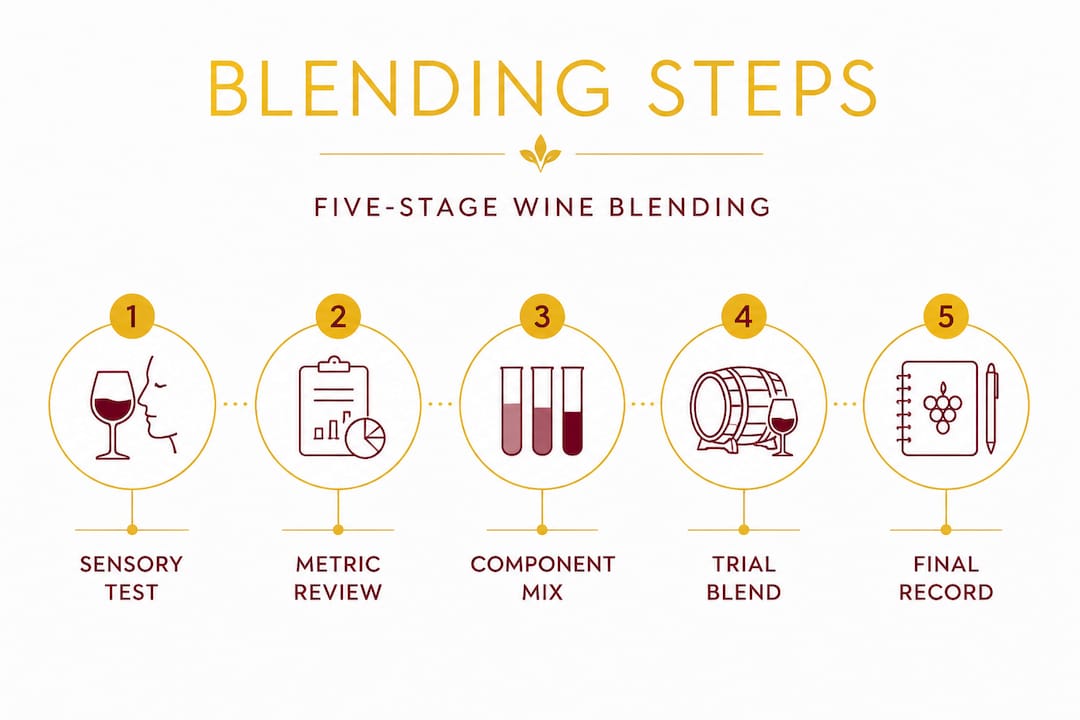
The standard blending methodology follows a five-stage process: sensory evaluation of individual lots for aromatics, acidity, tannins, and body; trial bench blends at 50 to 100ml; resting blends for 24 to 48 hours; scaling up to production; and post-blend monitoring. Each stage builds directly on the last. Skipping the rest period, for example, routinely produces a final blend that tastes disjointed in the glass because the components have not yet integrated at the molecular level.
Understanding how vineyard site impacts interact with lot character gives you a critical edge here. Two Syrah lots from the same appellation but different elevations and soil types will behave differently in a blend. The higher-elevation lot may carry fresher acidity and more restrained fruit, while the valley-floor parcel brings density and generosity. Your blending record sheets should capture these site variables, not just the sensory outcomes.
Pro Tip: Before your first formal blending session, taste each lot in isolation at least twice across different days. Your first impression will be shaped by context and fatigue. The second and third tastings reveal the genuine, stable characteristics you are actually working with.
| Stage | Action | Key metric |
|---|---|---|
| Sensory evaluation | Assess each lot individually | Acidity, tannin, aroma register |
| Bench blends | Trial at 50 to 100ml volumes | Ratio balance, initial integration |
| Rest period | 24 to 48 hours covered | Aromatic cohesion, colour stability |
| Scale-up | Reproduce winning ratio at full volume | Consistency with bench result |
| Post-blend monitoring | Assess over 2 to 4 weeks | Evolution, any negative changes |
Step-by-step wine blending methodology for sommeliers
Having prepared your environment and materials, you are ready to follow the professional blending process in detail. The sequence matters enormously and deviating from it introduces variability that can mislead even experienced palates.
- Sensory evaluation of all lots: Taste each component wine individually, noting primary aromas, structural acidity, tannin grain, mid-palate density, and finish length. Build a written profile for each lot before you combine anything.
- Hypothesis formation: Based on your sensory notes, identify which lots are likely complements. A high-tannin, aromatic Syrah pairs naturally with a round, generous Grenache. Note your target ratios before you begin pouring.
- Bench blending trials: Start with your most plausible hypothesis and trial at 50ml total volume. Use pipettes for accuracy. Taste immediately, then cover and rest.
- Rest period (24 to 48 hours): This is where the science of blending becomes critical. Tannins begin binding anthocyanins during rest, and volatile aromatic compounds redistribute across the combined liquid. What tastes disjointed immediately after combining often coheres beautifully after 48 hours.
- Re-evaluation and adjustment: Return to each rested bench blend and compare systematically. Adjust ratios in small increments, five percent at a time, and trial those as new bench blends.
- Selection and scale-up: Choose the winning bench blend and reproduce the ratio at production scale. Any deviation, even slight, should be documented.
- Post-blend monitoring: Assess the finished blend weekly for the first month. Look for unexpected changes in colour, aroma, or structure that might indicate instability.
Common pitfalls at this stage are predictable and avoidable. Over-complicating a blend by introducing too many lots simultaneously makes it nearly impossible to isolate what is driving the final character. Limit initial trials to two or three components until you have a working framework. Poor record-keeping is equally damaging; without precise ratios and dated tasting notes, you cannot reproduce success or diagnose failure.
“The craft of minimal-intervention winemaking teaches that your role is to reveal what is already present in the fruit, not impose your preferences over it.”
Blending rosé wine types adds another dimension to consider: colour integration. Direct-press rosé lots vary dramatically in hue depending on skin contact time and pressing pressure. When assembling a rosé blend, colour consistency across the final wine is an aesthetic target alongside the structural and aromatic goals.
Pro Tip: Keep a dedicated blending journal, not a spreadsheet alone. The texture of a tasting note, the way you describe an unexpected herbal quality or a jarring tannic edge, communicates information that numbers cannot capture. Your notes from three vintages ago may solve a problem you face today.
When and why timing matters: Scientific nuances of blending
With the standard blending process outlined, it is time to explore how timing and scientific tailoring refine results beyond what the standard protocol alone can achieve.
Timing in blending refers to when in the winemaking process the components are combined. Pre-fermentation blending, where varieties are co-fermented together, produces different aromatic and structural outcomes compared to post-fermentation assemblage. The former can encourage deeper integration of polyphenolic structures, while the latter preserves the individual character of each variety until the deliberate moment of combination.
The science is clear on specific pairings: post-MLF blending enhances colour intensity and stability in Syrah-based blends, including white Rhône-style assemblages, while pre-fermentation blending improves colour stability specifically in Graciano and Tempranillo combinations intended for extended ageing. For sommeliers working with Côtes du Roussillon producers, understanding these distinctions helps you articulate why a given Syrah-forward blend from the region carries such saturated, stable colour well into its second decade of life.
| Timing | Best suited for | Key benefit |
|---|---|---|
| Pre-fermentation | Graciano, Tempranillo, varieties for long ageing | Enhanced colour stability |
| Post-fermentation | Grenache, Mourvèdre, Syrah assemblages | Preserved varietal character per lot |
| Post-MLF | Syrah-dominant blends | Improved colour intensity and stability |
For aromatic complexity, timing also determines which volatile compounds survive. Early-stage blending exposes more delicate esters to fermentation-related heat and microbial activity, potentially diminishing floral and primary fruit characters. Late-stage blending, after both fermentation and malolactic conversion, preserves those aromatics intact until the final blend is assembled.
In French white blends from the south, this is particularly visible. A Roussanne lot blended post-fermentation retains its characteristic beeswax and apricot aromatics far better than one co-fermented with a more reductive Grenache Blanc. The timing choice is a deliberate creative and technical decision, not a matter of convenience.
A sommelier’s perspective: Why blending is artistry, not just chemistry
Here is something that took years to fully appreciate: the science of blending is essential, but it can become a trap if you mistake precision for understanding. The best winemakers in Roussillon, and the best sommeliers interpreting their work, share a quality that no protocol manual can instil. They respect what the vintage is actually saying rather than forcing it toward a predetermined recipe.
Blending to recipe, repeating last year’s ratios simply because they worked, ignores the most important variable: the living character of this year’s harvest. A Grenache from a cool, rain-influenced vintage carries a translucence and acidity that would be overwhelmed by the same Mourvèdre proportion that worked so well in a hot, concentrated year. The blend must respond to the wine it has, not the wine the recipe expects.
Vineyard site nuances compound this further. Two parcels of nominally identical variety and appellation produce fundamentally different lots when the soils and elevations diverge. Treating them as interchangeable in the blending room is an error that shows clearly in the glass.
Blending as deliberate craft for synergy, where tannins bind anthocyanins and acid sharpens fruit expression, requires that the winemaker understands not just what each component does chemically but what it means within the context of a house style and a regional identity. A Grenache-led GMS from Roussillon is not merely a ratio; it is a statement about place, about the relationship between elevation, heat, and old-vine concentration.
The competitive advantage for sommeliers lies here: being able to read a blend, to articulate the structural and aromatic logic behind the assemblage decisions, sets you apart immediately in trade conversations, wine list curation, and guest education. Intuition, trained by methodical practice and genuine curiosity, is not the opposite of rigour. It is rigour’s highest expression.
Explore and elevate: Take your blending journey further
Blending mastery is built through tasting, and tasting great blends is the fastest education available. If you want to benchmark your understanding of Roussillon assemblage against some of the finest examples from the region, the Res Fortes range offers precisely that reference point.
From the old-vine white blends to the Grenache-led flagship, every wine in the range reflects a deliberate blending philosophy rooted in terroir honesty and minimal intervention. For trade professionals looking to deepen their knowledge and access wines that exemplify southern French assemblage at its most expressive, the professional wine trade page offers dedicated support. Browse the full French blend selections or explore the award-winning reds to taste blending decisions in action, not just in theory.
Frequently asked questions
What is the main purpose of wine blending for sommeliers?
Blending creates balanced, complex wines that express a distinctive regional style; assemblage achieves outcomes that no single variety or lot can reach alone.
How do professional blend trials differ from amateur attempts?
Professionals use small bench blends, controlled rest periods, precise records, and systematic scale-up steps to ensure reproducibility and accuracy.
Does blending always improve a wine’s quality?
No; blending is architecture, not correction, and cannot rescue poor base wines or compensate for fundamental structural imbalances.
Why do some regions legally mandate blending?
Regions like Roussillon mandate blends to ensure the complexity and stylistic integrity that define the appellation’s traditional character.
What is the impact of blending timing on the final wine?
Timing affects colour stability and aroma complexity significantly; post-MLF blending enhances colour intensity in Syrah blends, while pre-fermentation work benefits Graciano-Tempranillo combinations destined for long ageing.
Recommended
- Why French white blends excel: Aroma, balance, and discovery – Res Fortes
- Vineyard sites and their true impact on wine quality – Res Fortes
- Discover what makes French boutique wineries unique – Res Fortes
- Wine Recipes - Res Fortes
- Wine Cellar Management | Cellared | Bespoke Wine Buying, Valuation & Cellar Management