
Wine awards are expert quality signals that help consumers identify technically sound bottles in a market of thousands of choices. Competitions like the Decanter World Wine Awards and the International Wine Challenge assess wines blind, under controlled conditions, and against category benchmarks. The result is a medal that tells you a panel of experienced tasters found the wine to be well made. Understanding why wine awards matter, and equally what they cannot tell you, is the difference between using them as a useful guide and treating them as a guarantee.
Why wine awards matter for buying decisions
Wine awards reduce consumer uncertainty by signalling expert evaluation and confirming a wine meets a recognised quality benchmark. That function is more valuable than it sounds. Walk into any supermarket or wine merchant and you face hundreds of labels, most of which offer no objective information about what is inside. A medal sticker cuts through that noise instantly.

The market evidence is clear. Medal-winning wines command roughly 13% higher prices than equivalent non-medal wines, confirmed by hedonic price analyses across multiple countries. That premium exists because buyers trust the signal enough to pay for it.
The shelf behaviour data is equally telling:
- Medal stickers markedly increase the likelihood that a shopper picks up a wine, particularly among less confident buyers.
- Awards function as instant reassurance cues, reducing the anxiety of choosing an unfamiliar bottle.
- Producers view awards as essential for market credibility, especially in saturated categories where marketing claims are everywhere.
The importance of wine awards extends beyond the individual shopper. Retailers use medal counts to inform ranging decisions. Importers use them to justify listings. Awards create a shared vocabulary of quality that benefits the entire supply chain.
Pro Tip: When you see a gold medal on a bottle, check which competition awarded it. A gold from the International Wine Challenge or Decanter carries more weight than a gold from a lesser-known regional show with no published judging criteria.
Are all wine awards created equal?
The credibility of a wine competition determines the value of its medals. Not all competitions are equal, and understanding the difference protects you from being misled by marketing-heavy awards that distribute medals generously.
| Feature | Credible Competition | Marketing-Heavy Competition |
|---|---|---|
| Judging method | Blind tasting, bottles wrapped | Open or semi-open tasting |
| Medal rate | Controlled, limited percentage | High proportion of entrants win |
| Transparency | Published scores and criteria | Vague or unpublished results |
| Judge credentials | Experienced professionals | Variable or undisclosed |
| Process oversight | Independent panels | Organiser-controlled |
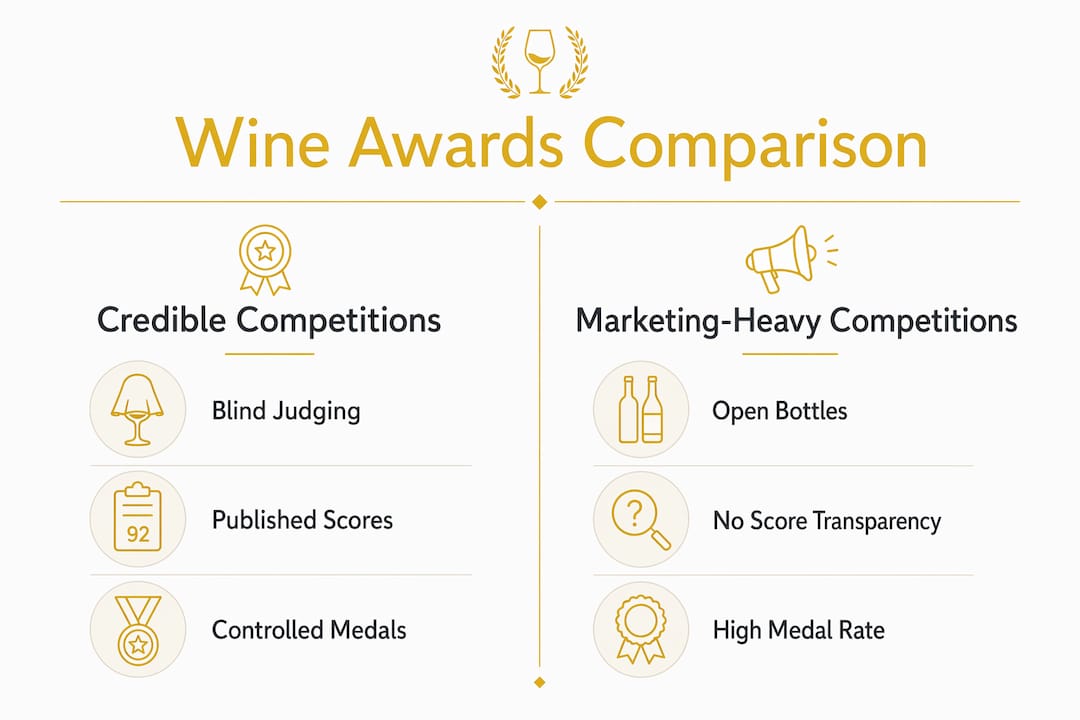
Reputable wine shows judge blind, with bottles wrapped and wines assessed side by side by experienced tasters. Blind tasting removes brand influence entirely. A judge cannot favour a famous label or a high price point when they cannot see either.
Controlled medal rates matter just as much. A competition that awards gold to 40% of entries tells you very little. A competition with a rigorous cut-off, where gold represents genuine best-in-category performance, tells you a great deal. The significance of wine show recognitions depends entirely on how seriously the organisers take that distinction.
Transparent scoring is the third pillar. Competitions that publish individual scores, panel notes, and judging criteria give consumers the tools to interpret a medal in context. Those that simply announce winners without explanation offer far less value.
Pro Tip: Before trusting a medal, look up the competition online. If you cannot find published judging criteria, medal percentages, or judge credentials within two minutes, treat the award with caution.
What wine awards tell you (and what they don’t)
Awards signal technical quality, balance, and the absence of faults. They do not tell you whether you will enjoy the wine. That distinction is the most important thing to understand about the value of wine ratings.
Awards compress complexity and reflect a snapshot taken in a controlled tasting room, not in your kitchen on a Tuesday evening with a plate of food. Judging conditions differ from everyday drinking in several important ways:
- Judges assess wines in flights of similar styles, which rewards wines that stand out within their category rather than wines that suit every occasion.
- Medals represent a moment in a wine’s life. A wine judged at 18 months may perform very differently at five years.
- Technical excellence does not equal personal pleasure. A wine can be faultless and still not suit your palate.
- Gold medals often reflect best-in-category in blind flights, so context is vital when interpreting awards relative to your own drinking preferences.
The benefits of wine competitions are real, but they are specific. A medal tells you a wine is well made. It does not tell you the wine pairs well with the food you cook, suits the occasion you have in mind, or matches the style you personally prefer. Treating a medal as a personal recommendation rather than a technical endorsement is the most common mistake consumers make.
The value of wine ratings also diminishes when you rely on a single medal from a single competition. One award is a data point. Multiple consistent awards across different competitions and different vintages are a pattern. Patterns are what you should trust.
How to use wine awards effectively when choosing
Using awards well is a skill. The goal is to treat them as a starting filter, not a final answer. Here is a practical approach that works whether you are shopping in a supermarket or browsing an online wine merchant.
- Use medals as a first pass. When you are unfamiliar with a producer or region, a medal from a credible competition confirms the wine is technically sound. That narrows your shortlist without requiring deep knowledge.
- Cross-check with trusted critics. Wine Enthusiast, Jancis Robinson, and the drinks business all publish scores and tasting notes. A wine that scores well in both a competition and with a respected critic is a stronger bet than one with a single medal.
- Look for repeated success. Consistent high scores across different competitions are better quality indicators than a single medal. A producer who wins at Decanter, the International Wine Challenge, and Fine Vintage in the same vintage is demonstrating genuine, repeatable quality.
- Match the award to your occasion. A gold medal in a full-bodied red category tells you the wine is serious and structured. If you want something light for a summer lunch, that medal is less relevant to your decision.
- Build your own reference points. Note which competitions consistently recommend wines you enjoy. Over time, you will learn which awards align with your palate, which makes them far more useful as personal guides.
Awards provide third-party validation that helps consumers navigate marketing claims in a crowded market. That validation is most powerful when you combine it with your own experience rather than replacing your judgement with it entirely.
For a deeper look at how to read wine accolades as quality patterns, the Resfortes blog breaks down what consistent recognition across competitions actually signals about a producer’s craft.
Key takeaways
Wine awards are reliable quality filters when drawn from credible competitions, but they signal technical excellence rather than personal taste fit.
| Point | Details |
|---|---|
| Awards reduce uncertainty | Medals from credible competitions confirm technical quality and help narrow choices on crowded shelves. |
| Price premium is real | Medal-winning wines command roughly 13% higher prices, reflecting genuine market trust in award signals. |
| Not all competitions are equal | Blind judging, controlled medal rates, and transparent scoring separate credible awards from marketing exercises. |
| Awards are snapshots | A medal reflects quality at one moment in time and does not predict ageing, food pairing, or personal enjoyment. |
| Patterns beat single medals | Consistent recognition across multiple competitions and vintages is a far stronger quality signal than one award. |
Why i think most people use wine awards backwards
People treat a medal as the end of the decision. I think it should be the beginning. The real skill is using an award to open a door, then walking through it with your own curiosity.
I have tasted technically flawless wines that left me cold and modestly awarded bottles that stopped me mid-conversation. Awards are not wrong in those cases. They are simply answering a different question than the one you are asking. A competition asks: is this wine well made within its category? You are asking: will I enjoy this tonight?
The wines I return to most consistently are ones where the awards and my own experience converge. Resfortes’ The Brave, for example, has earned recognition from the drinks business and Wine Enthusiast not because it chases a competition formula, but because old-vine Grenache from the Côtes du Roussillon, made with minimal intervention, genuinely delivers something distinctive. The awards confirm what the glass already tells you.
My honest advice is to use wine character knowledge alongside award information. Understand what you like stylistically, then use medals to find producers who make that style well. That combination is far more reliable than either approach alone.
Awards are helpful guides. They are not your palate. Trust both, and you will choose better wine.
— Moritz
Discover Resfortes’ award-winning wines
Resfortes produces wines from the Côtes du Roussillon that have earned recognition from the drinks business, Wine Enthusiast, Fine Vintage, and top Vivino reviewers. Each bottle in the range reflects the same qualities that credible competitions reward: technical precision, genuine terroir expression, and consistent quality across vintages.
The range spans the citrus-laced Rosé, expressive old-vine White blends, the Grenache-led GMS, the estate Syrah Traveller, and the flagship The Brave. If you want wines where the awards and the glass tell the same story, explore the full Resfortes wine collection and find your next trusted bottle. Free shipping applies on three bottles or more across the UK and France.
FAQ
What do wine awards actually measure?
Wine awards measure technical quality, balance, and the absence of faults as assessed by experienced tasters in blind conditions. They confirm a wine is well made within its category but do not indicate personal taste fit.
How do i know if a wine competition is credible?
Look for blind judging, published scoring criteria, controlled medal rates, and named judge credentials. Competitions like the International Wine Challenge and Decanter World Wine Awards publish this information openly.
Do award-winning wines cost more?
Medal-winning wines command roughly 13% higher prices than non-medal equivalents, based on hedonic price analyses across multiple countries. Gold-level awards drive the strongest price premium.
Should i always buy a wine with a medal over one without?
Not necessarily. Use medals as a quality filter, then cross-check with trusted critics and your own past preferences. A wine with consistent recognition across multiple competitions is a stronger choice than one with a single medal from an unknown show.
Why do some good wines never win awards?
Some producers do not enter competitions, either by choice or due to cost. An absence of medals does not mean poor quality. It means the wine has not been formally evaluated, which is a different thing entirely.