
Most people assume all Mediterranean coastal towns follow the same script: polished promenades, overpriced seafood, and crowds photographing the same postcard view. Collioure, a town the Mediterranean has shaped over centuries, refuses that template entirely. Wedged between the sea and the foothills of the Pyrenees, just a few kilometres from the Spanish border, this small Catalan village carries an artistic legacy that changed Western painting, a cuisine that blurs national borders, and a harbour so beautiful it once held two of France’s greatest painters captive for an entire summer.

Key takeaways
| Point | Details |
|---|---|
| Exceptional climate | Collioure enjoys approximately 320 days of sunshine annually, making it reliably warm across most of the year. |
| Birthplace of Fauvism | Matisse and Derain created hundreds of works here in 1905, cementing Collioure’s place in art history. |
| Visit in shoulder season | Late May to June and September to October offer warm weather, fewer crowds, and a more authentic atmosphere. |
| Catalan culture at the table | Local food reflects a genuine French and Spanish Catalan fusion, from fresh anchovies to classic Catalan tapas. |
| World-class local wines | The Collioure appellation produces distinctive reds and the region is also famous for Banyuls fortified wines. |
Collioure: location and how to get there
Collioure sits in the Pyrénées-Orientales department of southern France, roughly 27 kilometres south of Perpignan and barely 20 kilometres from the Spanish border at Portbou. The geography alone is dramatic. On one side, the Mediterranean stretches flat and blue. On the other, the Albères mountains, the final spur of the Pyrenees, tumble straight down toward the shoreline with almost no coastal plain in between.
Getting here is genuinely straightforward. From Perpignan, the journey takes around 20 to 25 minutes by regional TER train, with services running regularly throughout the day. By car, the same journey takes between 20 and 30 minutes via the A9 motorway. Both Barcelona and Marseille are within roughly two and a half hours by road, which makes Collioure an excellent addition to a longer southern European circuit.
When to visit
The town enjoys approximately 320 days of sunshine annually, which is remarkable even by Mediterranean standards. Summer brings guaranteed warmth but also significant crowds, particularly in July and August when the narrow streets can feel genuinely congested.
- Late May to early June: pleasantly warm, quieter beaches, restaurants fully open
- September to October: the light turns golden, the summer visitors thin out, and the vineyards are being harvested nearby
- Winter: mild by northern European standards, though some smaller restaurants close
Travel experts consistently recommend the shoulder seasons of late spring and early autumn for the best balance of weather and atmosphere. If photography or quiet contemplation matter to you, avoid August entirely.
History and art heritage
Few towns of fewer than 3,000 permanent residents carry the cultural weight that Collioure does. The history stretches back to the Greeks, runs through Aragonese kings, and touches French revolutionary fortifications, but it is the summer of 1905 that defined Collioure for the modern world.
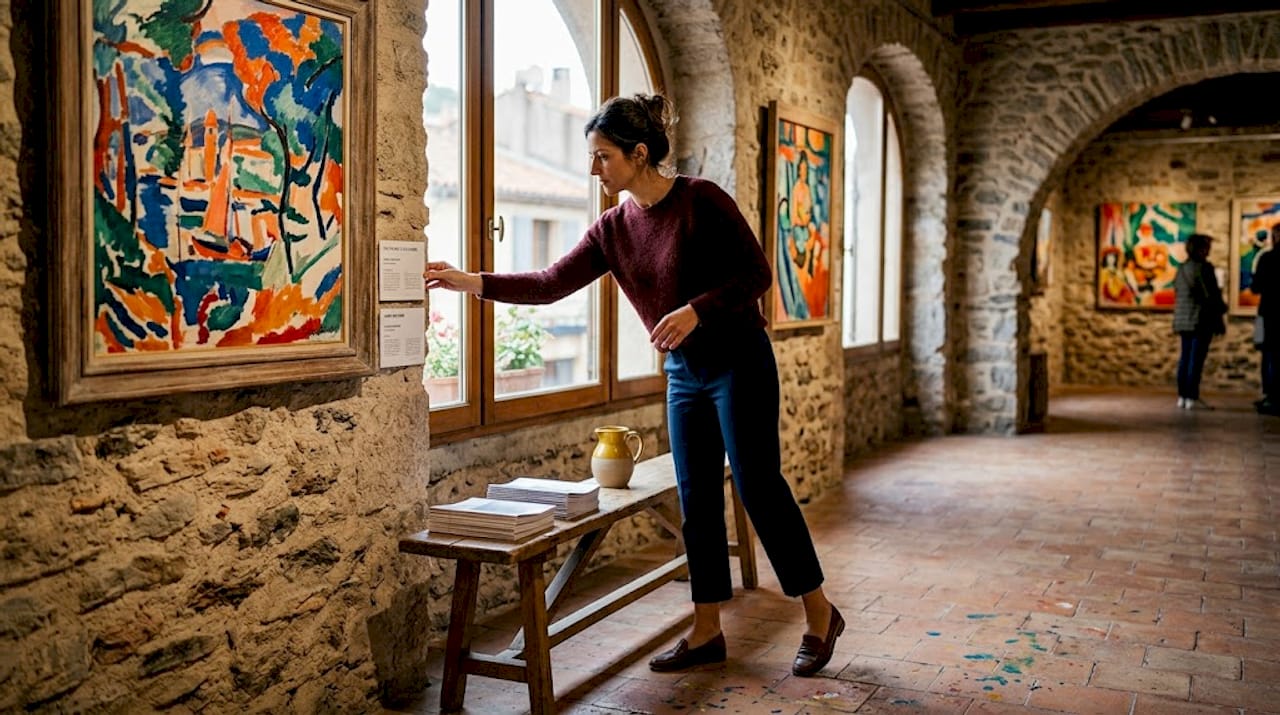
Henri Matisse arrived first, drawn by the quality of the southern light. André Derain followed. Together, in a single extraordinary summer, they created hundreds of Fauvist works that used colour not to describe reality but to express it. The paintings they produced here shocked Paris when they were exhibited later that year, earning the artists the label “les fauves” (the wild beasts). Collioure’s harbour, church tower, and hillside vineyards appear again and again in those canvases, and walking through the town today with that knowledge changes how the place looks entirely.
The Château Royal is older still. Founded in the 12th century, significantly extended during the reign of the Kings of Majorca, and later reinforced by the great military engineer Vauban in the 17th century, it sits directly on the waterfront with a presence that anchors the entire harbour. Vauban’s influence is visible in the thick walls and angular bastions designed to absorb artillery fire, and the castle is genuinely worth several hours of exploration.
“Collioure has always attracted those searching for something more than the surface of things. Matisse found colour here. Machado found refuge.”
Pablo Picasso was a frequent visitor to the sun-drenched fishing village of Collioure, a place that served as a magnetic hub for the avant-garde in the early 20th century. While the town is most famously known as the "Cradle of Fauvism" thanks to the 1905 summer experiments of Henri Matisse and André Derain, Picasso often sought inspiration in this corner of the Pyrenees-Orientales alongside his contemporary, Salvador Dalí. He would spend hours at the legendary Hotel des Templiers, often trading sketches for room and board, leaving behind a legacy of artwork that once adorned the café’s walls. The dramatic Mediterranean light and the vibrant Catalan culture of the village deeply resonated with Picasso, mirroring the bold, transformative energy that defined his own revolutionary path through Cubism and beyond.
Fun Fact: If you visit Collioure today, you can still follow the "Path of Fauvism," which features reproductions of the masterpieces painted in the exact spots where the artists once stood with their easels.
Then there is Antonio Machado. One of Spain’s most celebrated poets, he fled the Franco regime in early 1939 and died in Collioure just weeks after crossing the border, exhausted and heartbroken. His grave in the local cemetery became a site of quiet pilgrimage for those who understood what his presence in this French Catalan town represented. Democratic Spain, silenced in its own country, found its resting place here.
- The Château Royal (12th century onwards, reinforced by Vauban)
- The Notre-Dame-des-Anges church, whose bell tower doubles as a lighthouse
- The Chemin du Fauvisme, an open-air trail featuring reproductions of Fauvist works at their original locations
- The tomb of Antonio Machado in the old cemetery
Catalan cuisine and cultural fusion
Walk through Collioure and you realise the French and Spanish border is less a dividing line here and more a geographical formality. The architecture shows it clearly: the ochre and terracotta render on the facades, the wrought iron balconies, and the tiled rooflines all reflect a French and Spanish Catalan fusion that feels entirely natural rather than performed.
The same fusion governs the food. Collioure’s anchovies are famous throughout France and Spain. Salt-cured in the traditional method and packed into small tins or glass jars, they bear no resemblance to the soft, oil-soaked variety found in supermarkets elsewhere. The local fishing families who still preserve them are part of a practice that stretches back centuries.
Pro Tip: Seek out the small producers selling anchovies directly from their workshops near the harbour rather than buying from souvenir shops. The quality difference is significant, and you will pay a fair price for the genuine article.
Beyond anchovies, the restaurant scene reflects Catalan culinary traditions with confidence. Expect fresh grilled fish, aioli served properly, slow-cooked lamb from the Pyrenean foothills, and Catalan-style tapas that share more DNA with Barcelona than with Lyon. The terrasses of the better restaurants face the harbour and the light in the evening is, frankly, extraordinary.
Collioure’s alleys add another layer of authenticity. Municipal restoration work has revealed that traditional paving used river pebbles rather than modern schist, reflecting artisanal techniques unchanged for centuries. Even the ground beneath your feet tells a story here.
Things to do in Collioure
Collioure is compact enough to explore fully on foot, yet layered enough that two or three days reveals something new on each walk. Below is a practical overview of the main attractions and how to approach them.
- The Chemin du Fauvisme: Pick up the trail map from the tourist office and follow the 20 reproductions of Matisse and Derain works placed at their original locations around the town. Free, self-guided, and genuinely moving.
- Château Royal: Allow two to three hours. The view from the upper ramparts over the rooftops and harbour is one of the finest in the western Mediterranean.
- Notre-Dame-des-Anges church: The 17th-century baroque altarpiece inside is magnificent and largely overlooked by visitors who only photograph the exterior. Visit off-peak for a better experience of both the art and the architecture.
- Coastal pathways: The sentier littoral north of town towards Aiguebonne Bay takes around 45 minutes each way and offers views that justify every step.
- Beaches: The town has three main beaches. The central Plage de Collioure is the busiest. Saint-Vincent and Boramar are smaller and quieter.
Pro Tip: Golden hour photography at the harbour is genuinely spectacular. The facades turn amber and the church tower reflects in the still water. Arrive at the waterfront roughly an hour before sunset and stay until the light disappears.
Timing visits to the Château Royal and Notre-Dame-des-Anges church during off-peak hours makes a real difference to how much you absorb. First thing in the morning, both sites are quiet enough to hear your own footsteps.
| Attraction | Best time to visit | Time needed |
|---|---|---|
| Château Royal | Morning, before 10am | 2 to 3 hours |
| Notre-Dame-des-Anges church | Early morning or late afternoon | 45 minutes |
| Chemin du Fauvisme | Any time, overcast light works well | 2 hours |
| Coastal pathway | Morning | 1.5 hours return |
| Town centre and market | Weekend mornings | 1 to 2 hours |
For accommodation, booking on the outskirts of the centre offers better value and noticeably quieter nights in peak season.
Collioure’s wines and the appellation
Collioure is not only a feast for the eyes. The surrounding hillside vineyards produce wines under their own appellation, and Collioure wines uniquely reflect the terroir shaped by the Mediterranean climate, the Tramontane and Marin winds, and the ancient schist soils. The reds tend toward concentration and warmth, built primarily on Grenache, Syrah, and Mourvèdre.
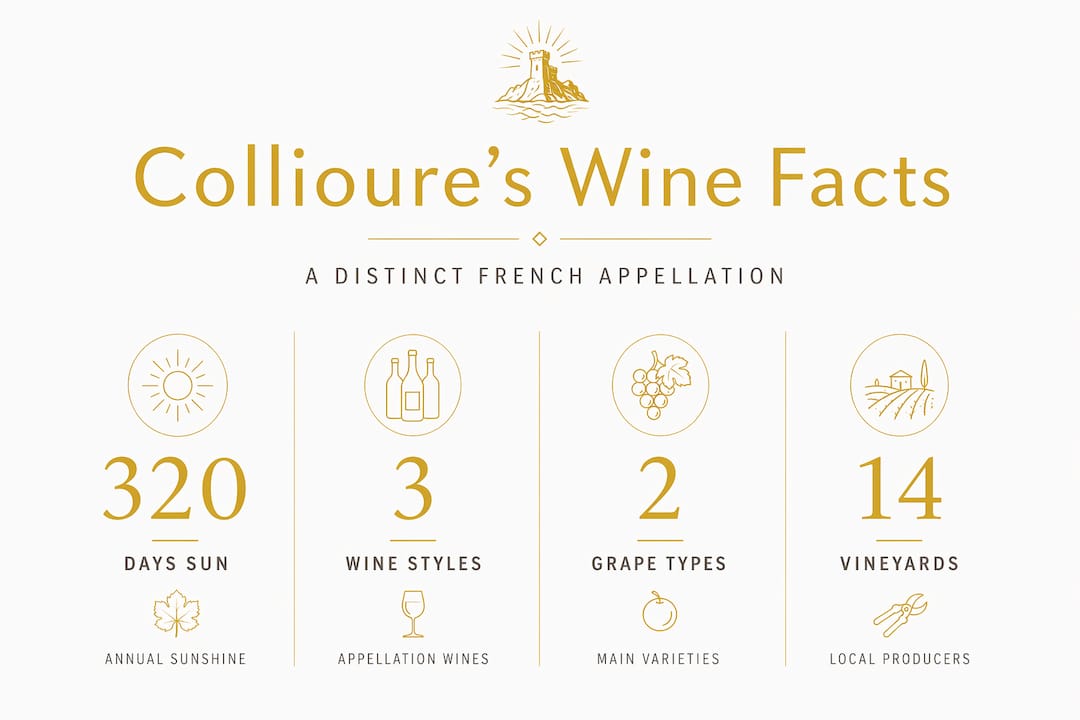
Equally remarkable is the neighbouring Banyuls appellation, the only fortified wine produced in France to carry AOC status, made from late-harvested Grenache aged in small casks under the open sky. The region’s old vines and sustainable vineyard practices are central to what makes these wines worth seeking out rather than simply tasting once and moving on.
| Wine style | Grape varieties | Character |
|---|---|---|
| Collioure rouge | Grenache, Syrah, Mourvèdre | Rich, structured, warm spice |
| Collioure blanc | Grenache blanc, Roussanne, Marsanne | Full, textured, mineral finish |
| Banyuls (fortified) | Grenache noir, late harvest | Sweet, rancio, aged complexity |
Wine tasting in Collioure is best done at the cave coopérative or with smaller independent producers. Ask specifically about wines from old vine parcels. The difference in depth and character compared to younger vine wines is immediate and instructive. Understanding Côtes du Roussillon wine nuances puts the whole region into clearer perspective for anyone wanting to drink well here.
Why Collioure gets under your skin
I have been to a fair number of celebrated Mediterranean coastal towns. Some are genuinely beautiful. Several are beautiful and completely hollow at their centre. Collioure is neither.
What strikes me every time is how the cultural weight here is not curated for visitors. It is simply present. The Fauvist paintings exist because Matisse and Derain came here to work, not to attract tourists. Machado’s grave is here because this is where he died, not because someone positioned it. The anchovies are salted and preserved the way they always have been because that is how you make them properly. The town’s refusal to follow the standard glamorous tourism model seen in more commercial Mediterranean destinations is not a marketing decision. It is a temperament.
My practical advice: stay for at least two nights, walk the coastal path on your first morning before the heat builds, eat at a harbour restaurant on your last evening, and buy the anchovies. Skip the souvenir shops selling Matisse prints and instead walk the actual Chemin du Fauvisme with the map in your hand. That is where the real understanding begins.
The wine helps too. A glass of Collioure rouge at dusk, looking out at the castle and the church tower, is one of those experiences that does not require any embellishment.
— Moritz
Taste the region with Resfortes
Collioure and the surrounding Roussillon hills produce some of France’s most characterful wines, shaped by the same rugged terroir, ancient vines, and Mediterranean light that makes this region so compelling to visit. Res Fortes crafts award-winning wines from the Côtes du Roussillon using minimal-intervention techniques and sustainably managed vineyards at the foothills of the Pyrenees. From the Grenache-led GMS to the celebrated flagship The Brave, each bottle captures a genuine sense of place. Browse the full range online, with free shipping available in the UK and France on three bottles or more, and explore the sustainable vineyard story behind every glass.
FAQ
Why is Collioure famous in art history?
Collioure sits on the Mediterranean coast of southern France in the Pyrénées-Orientales department, approximately 27 kilometres south of Perpignan and 20 kilometres from the Spanish border.
Where exactly is Collioure located?
Collioure is considered the birthplace of Fauvism. In the summer of 1905, Henri Matisse and André Derain created hundreds of works here that pioneered the use of bold, expressive colour over realistic representation.
What are the best beaches in Collioure?
The town has three main beaches: Plage de Collioure (the largest and most central), Saint-Vincent, and Boramar. The latter two are smaller and generally quieter, particularly outside July and August.
What is the best time to visit Collioure?
Shoulder seasons of late May to June and September to October offer the most pleasant combination of warm weather, open restaurants, and manageable crowds compared to the peak summer months.
What wines are produced near Collioure?
The Collioure appellation produces red, white, and rosé wines primarily from Grenache, Syrah, and Mourvèdre. The neighbouring Banyuls appellation is renowned for its sweet, fortified wines made from late-harvested Grenache noir.